Save $400.00
The Xlaserlab X1 Pro: A Handheld Laser Welder That Combines Four Tools in One Weld stainless steel, aluminum, and carbon steel with professional ...
View full detailsAluminum welding is notoriously difficult with traditional methods. TIG requires immaculate surface preparation and years of technique refinement; MIG on aluminum produces inconsistent results, porosity, and significant heat distortion. A handheld fiber laser welder addresses both problems: the highly concentrated beam melts aluminum cleanly with minimal heat-affected zone, dramatically reduced warping, and lower porosity risk compared to arc methods. Laser welders handle aluminum 5052, 6061, 6063, and most common alloys with argon shielding gas, and can weld aluminum without the strict surface-cleanliness requirements that TIG demands — making the process faster to set up and more forgiving to run.
The most important variable for laser welding aluminum is power: aluminum's high thermal conductivity and reflectivity mean that 1500W or higher is recommended for reliable results, particularly on material above 1.5mm. We recommend starting on stainless steel to develop your standoff distance and travel speed feel before moving to aluminum. Our collection includes machines with the power and process margin for clean aluminum welds — and our team can advise on the exact settings, wire selection, and gas flow rates for your specific aluminum alloy and joint type. Book a free pre-purchase consultation before buying for aluminum-focused applications.
Save $400.00
The Xlaserlab X1 Pro: A Handheld Laser Welder That Combines Four Tools in One Weld stainless steel, aluminum, and carbon steel with professional ...
View full details
Sale
xTool MetalFab: One Machine. A Complete Metal Workshop. Weld, Cut, Clean, and Engrave — All with Industrial-Grade Fiber Laser Precision. The xTool...
View full details
Save $1,000.00
Cut Faster, Weld Cleaner, and Work Anywhere with the Gweike Gweike 3-in-1 Handheld Laser Welder. The Gweike 3-in-1 Handheld Laser Welder redefines ...
View full details
Save $-3,699.00
The Xlaserlab X1: The Lightest, Most Accessible Handheld Laser Welder for Thin Metal Work Clean, precise welds on stainless steel, carbon steel, b...
View full details
Save $1,000.00
Cut Faster, Weld Cleaner, and Work Anywhere with the Gweike Gweike 3-in-1 Handheld Laser Welder. The Gweike 3-in-1 Handheld Laser Welder redefines ...
View full details
Save $-39,000.00
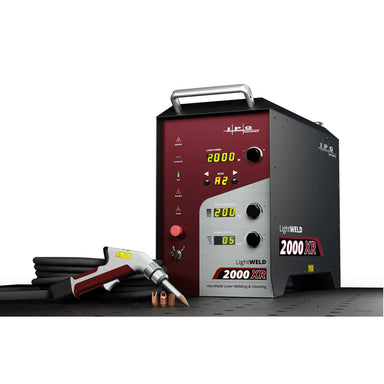
Experience unmatched speed, precision, and cleaning power with the IPG LightWELD 2000 XR Handheld Laser Welder With the LightWELD 2000 XR Handheld ...
View full details
Save $-27,750.00
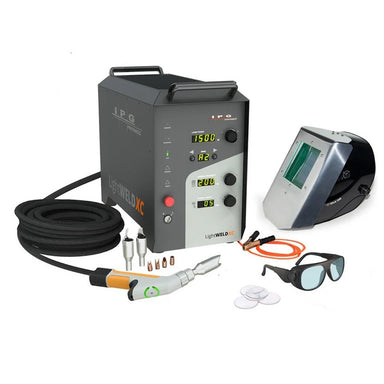
A smarter, faster way to weld and clean with the 1500 XC Laser Welder Machine IPG LightWELD brings the best of modern laser welding and cleaning in...
View full details
Save $-33,000.00
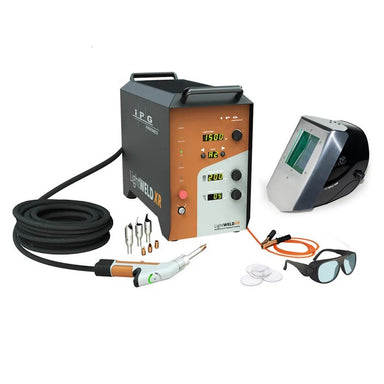
IPG LightWELD 1500 XR Handheld Laser Welder — Revolutionize Your Welding Experience The IPG LightWELD 1500 XR Handheld Laser Welder brings unmatche...
View full details
Save $-22,500.00
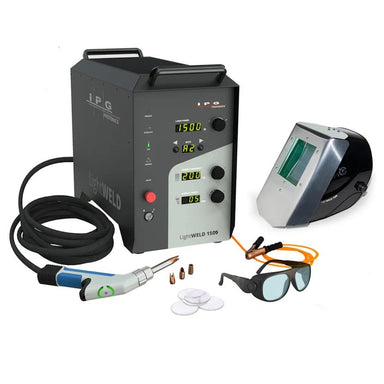
Unleash Industrial Power and Precision with the IPG LightWELD 1500 The LightWELD 1500 Handheld Laser Welding System delivers unmatched power, preci...
View full details
Save $-18,000.00
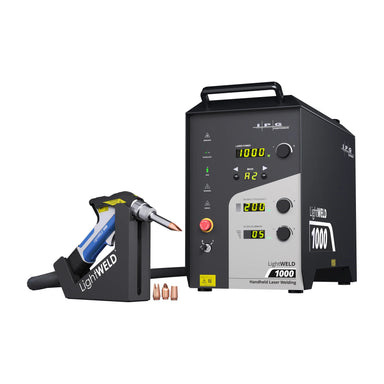
Cut Faster, Weld Cleaner, and Boost Productivity with the IPG LightWELD 1000 The LightWELD 1000 Handheld Laser Welding System is changing the game...
View full detailsFor thin-to-medium aluminum (0.5mm to 3mm), laser welding is faster, produces less distortion, and requires significantly less surface preparation than TIG. TIG welding aluminum demands immaculate cleaning (oxide layer removal with stainless brush), precise torch angle, and AC current control — skills that take years to develop. A fiber laser welder can fuse aluminum with more forgiving surface conditions because the beam's energy density partially ablates surface contaminants. The resulting welds show less warping, minimal porosity when parameters are correct, and faster travel speeds— typically 3–5x faster than TIG on comparable thickness. Where TIG still wins is on material above 6mm and on complex joint geometries where the broad filler puddle of TIG is more adaptable.
Aluminum's high reflectivity and thermal conductivity mean it demands more power than stainless steel of the same thickness. As a practical guide: 700W handles thin aluminum under 1.5mm but with narrower process margins;1000–1200W is the practical minimum for reliable aluminum welding up to 2.5mm; and1500W+ gives you the margin needed for 3mm aluminum and above, as well as more stable results on reflective alloys like 6061. If aluminum is a primary material for your work — not just occasional — we recommend 1500W as your starting point. Attempting aluminum on underpowered machines produces cold-lap defects and inconsistent penetration that can look fine on the surface but fail structurally.
Argon is the required shielding gas for laser welding aluminum— nitrogen is not suitable as it can react with the aluminum melt pool. Use high-purity argon (99.99% minimum) at a flow rate of 20–30 L/min. Helium or argon/helium mixtures are used in higher-power industrial applications to improve energy absorption and reduce porosity on thick aluminum, but pure argon is appropriate for all handheld applications in the 700W–2000W range. Insufficient argon flow rate is one of the most common causes of porosity in aluminum laser welds — err on the side of higher flow, especially in the first sessions as you dial in your technique.
Porosity in aluminum laser welds is almost always caused by one of three things: insufficient argon shielding, surface contamination, or inadequate power for the material thickness. Aluminum forms a stubborn oxide layer (alumina) that, if not adequately displaced by the laser energy and gas coverage, traps gas in the weld pool as it solidifies. Before welding, clean the surface with a dedicated stainless steel wire brush (never one used on other metals) and wipe with acetone. Ensure argon flow is above 20 L/min with no drafts disturbing the coverage. If porosity persists at adequate gas flow and surface cleanliness, increase power — insufficient energy density is the remaining cause. Using a wire feeder with aluminum-specific wire (ER4043 or ER5356 depending on alloy) also helps bridge gaps and reduce porosity on butt joints.
The two most common aluminum filler wires are ER4043 and ER5356. ER4043 (4% silicon) has lower melting point, better flow, and lower cracking sensitivity — it is the first choice for general aluminum welding, 6061, and most automotive or structural applications. ER5356 (5% magnesium) produces a stronger weld with better corrosion resistance in saltwater environments — it is preferred for marine applications and 5xxx series base alloys. For most shop applications, 0.8mm diameter wire is appropriate for material under 2mm; step up to 1.0mm for thicker sections. Never use ER4043 on aluminum alloys containing more than 2% magnesium, as it can create a brittle joint.
Shipping Insurance ($89)