

Save $251.00
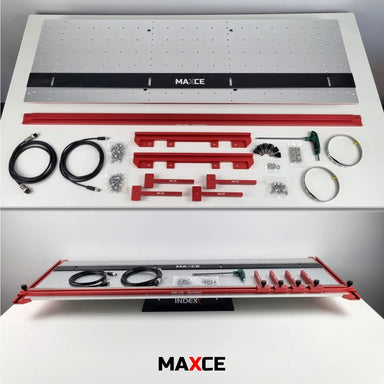
Turn Your Fiber Laser Into A High-Efficiency Production Line With The Maxce Index X Laser Marking Production Table The Maxce Index X Laser Marking...
View full detailsThe Maxce Index X Laser Marking Production Table is your go-to production table attachment for galvo laser marking machines—bringing professional-grade automation and flexible fixturing to your workflow.
Designed for plug-and-play compatibility with fiber lasers, for small shops to growing operations, IndexX helps you mark faster, more accurately, and with less hassle.
Save $251.00
Turn Your Fiber Laser Into A High-Efficiency Production Line With The Maxce Index X Laser Marking Production Table The Maxce Index X Laser Marking...
View full detailsA rotary indexing table lets an operator load the next part while the laser marks the current one, so loading happens in masked time instead of pausing the laser between parts. On a manual setup, every part swap stops the laser and adds several seconds of dead time per cycle; on a production run of hundreds of parts a day, that adds up to a significant chunk of lost throughput. With an indexing table, the laser keeps marking on one station while the operator fixtures the next part on the other, effectively overlapping the two steps. That overlap is what lets shops running fasteners, tools, or small metal parts hit meaningfully higher parts-per-hour numbers.
It positions and rotates workpieces at precise, repeatable intervals so multiple parts can be marked in sequence without manual repositioning, which is critical for consistent placement across high-volume batch runs. Indexing tables typically hold repeatability tolerances within a fraction of a millimeter, so a logo or serial number lands in the same spot on part 500 as it did on part 1. That consistency is difficult to achieve by hand, especially on small parts like fasteners, tools, or jewelry components where even slight misalignment is visible. Manufacturers running daily batch production rely on this repeatability as much as the speed gain it provides.
Yes — the dual-position rotary design lets the laser mark one face while the next part is fixtured, and rotating the fixture between marking stations allows consistent marking across multiple sides of the same part. This is especially useful for parts that need a logo on one face and a serial number or date code on another, since the operator can flip or re-index the part between marking passes without removing it from the fixture entirely. Cycle time stays low because the laser rarely sits idle waiting on a part change. For production runs needing marks on more than one surface, this setup avoids the manual repositioning that would otherwise slow the line down.
Shipping Insurance ($89)
placeholder