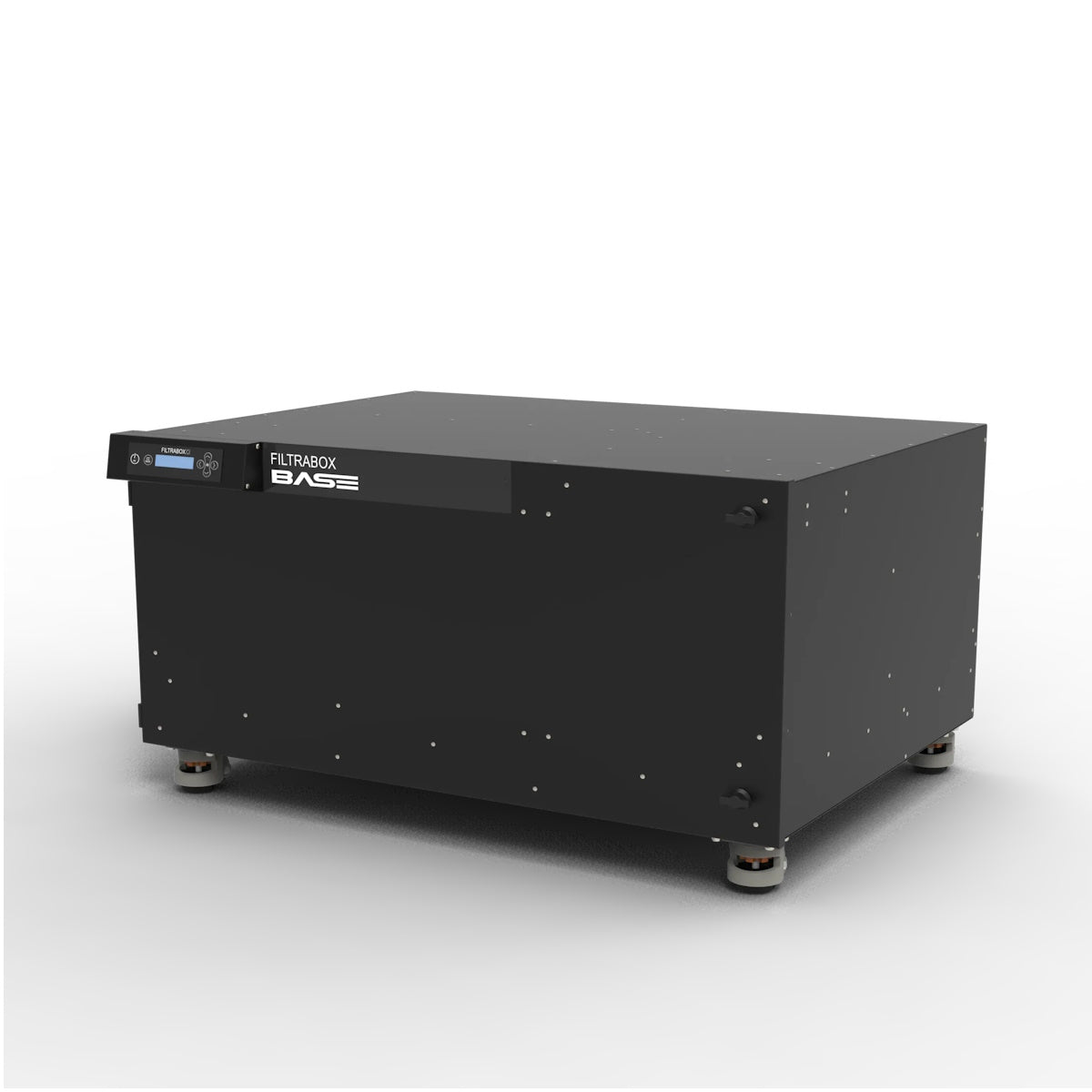
Your Fume Extractor and Your Laser Stand. One Machine.
The Filtrabox Base is a professional-grade 3-stage laser fume extractor that replaces your laser's OEM table or supports — you set your laser cutter or engraver directly on top of it, saving floor space and eliminating the separate footprint of a conventional fume extractor. Available in four configurations from 235 CFM single-blower to dual-blower production capacity, it's built with intelligent flow control, EZ-Link laser connectivity, and the modular serviceability that makes field repairs fast and simple.
The Problem It Solves That You Might Not Have Thought About
Most laser operators set up their machine on a table, then add a separate fume extractor somewhere nearby — connected via hose to the laser's exhaust port. This works, but it has costs that accumulate silently.
You need two footprints: one for the table, one for the extractor. The extractor either sits on the floor in the traffic path or gets pushed under a bench where filter access becomes difficult. The hose run adds length, adds bends, adds pressure drop — all of which reduce actual extraction efficiency. And you have two things to move when the shop gets reorganized.
The Base delivers professional-grade air purification for laser cutting and engraving while also replacing the OEM table or supports. Place the laser directly on top of the Base for an efficient workspace.
One footprint. One unit. The laser sits on top, the extractor is underneath, and the whole system takes up exactly the space your laser occupied before.
3-Stage Separated Filter Cartridges — and Why Separation Matters
The Filtrabox Base uses three individually separated filter stages, each in a rigid aluminum cartridge, each optimized for a different contaminant type. The separation isn't a marketing detail — it directly affects how much you spend on replacement filters over time.
Different materials produce different proportions of dust vs. VOC gases. Lasering acrylic produces 90% VOC gases and 10% dust. Lasering wood produces 10% gases and 90% dust. With individually separated filters, each filter can be replaced when it's actually spent — which varies with each material lasered.
With a combined HEPA/carbon cartridge (the type most lower-cost extractors use), when the carbon portion is exhausted you replace the entire cartridge — including a still-functional HEPA stage. With the Base, you replace only what's spent.
Stage 1 — F9 Pre-Filter: Removes the majority of submicron respirable dust before it reaches the HEPA stage, protecting the HEPA filter from premature loading. Mini-pleat glass fiber media in a rigid aluminum cartridge — no bypass risk from filter frame flex. This stage is doing the heavy particle work so the HEPA lasts longer.
Stage 2 — HEPA Filter (99.999% @ 0.3 microns): Tested at 99.999% efficiency at 0.3 microns — the most aerodynamically penetrating particle size. Smaller and larger particles are captured at even higher efficiency, resulting in extremely clean air free of respirable dust. The rigid aluminum cartridge ensures the rubber seals maintain contact under the high negative pressure generated by the blower — cardboard-cased filters flex under this pressure and leak.
Stage 3 — Gas Filter (Activated Carbon + Potassium Permanganate): Removes the broadest spectrum of laser-generated VOC gases at the molecular level. 40 lbs of adsorption media on the base configuration, 80 lbs on the Base+, Base Pro, and Base Pro2. The blend of high-grade activated carbon and potassium permanganate removes the broadest spectrum of gases — eliminating virtually any smells and odors from laser operations including acrylic, rubber, leather, and more.

Intelligent Flow Control — Consistent Performance as Filters Load
One of the least-discussed problems with fume extractors is what happens as filters load over time. As dust accumulates, filter resistance increases and airflow drops — which means the machine is extracting progressively less effectively as it approaches filter change time. Most extractors don't tell you this is happening, and they don't compensate for it.
The Base's advanced sensors and digital controls automatically adjust airflow to maintain optimal extraction as filters load, ensuring consistent performance throughout the filter lifecycle.
This means extraction effectiveness doesn't degrade gradually over the filter's life — the machine maintains its specified performance from day one through the point where filter replacement is actually needed. The integrated pressure monitoring tells you when that point arrives, so you're replacing filters based on actual loading, not a guessed schedule.
EZ-Link: The Extractor Runs When Your Laser Runs
Most fume extractor operators either leave the unit running all day (wearing out filters and motor) or have to remember to turn it on before every job and off after (and inevitably forget one or the other).
EZ-Link laser connectivity seamlessly integrates the Base with your laser system for automated operation. The intelligent connectivity ensures the extractor runs only when needed, saving energy and extending filter life.
When your laser fires, the Base starts. When the job ends, the Base continues briefly to clear residual fume, then shuts down. The integration is a simple hardwired connection — no software, no programming. Laser on = extractor on, automatically.
For shops running production volumes where the laser cycles repeatedly throughout the day, this automation also means the carbon gas filter isn't being run continuously while the laser is idle — extending the life of the most frequently replaced (and most expensive) filter stage.
Modular Serviceability: Field Issues Fixed Without Sending the Machine Back
The Filtrabox Base contains electronics, sensors, blower control systems, and flow monitoring — more complexity than a simple single-speed fan extractor. Complex electronics create a potential service concern: when something goes wrong, how quickly can it be fixed?
Filtrabox has simplified the Base by consolidating all components into three simple, removable modules: the Electronics Module (blower control and power systems), the Blower Module (blower and flow sensor), and the User Interface Module (user interface components). In the event of a field issue, tech support need only diagnose three modules to quickly dispatch the appropriate replacement. The modules are simple to replace with only a few plug-and-play wire harnesses — no tech experience required.
This matters practically: if there's ever a component issue, you receive the replacement module, unplug the old one, plug in the new one, and the machine is back in service. No shipping the entire unit. No extended downtime while waiting for a repair facility. No tech required.
Choose Your Configuration
The Base platform is available in four configurations scaled to your laser system and production volume:
Base — Entry Level (235 CFM) The right starting point for small laser systems and light-duty applications. 6 m² pre-filter and HEPA, 40 lbs carbon, 50 dB. Suitable for CO2 laser engravers in the 30–80W range running moderate daily sessions. Runs at 6A on 240V or 12A on 120V.
Base+ — Double Carbon (235 CFM) Same airflow and particle filtration as the Base, but with 80 lbs of carbon gas media — double the capacity for shops processing higher VOC-generating materials like acrylic, rubber, and coated surfaces regularly. The right choice when odor control is a priority alongside particle filtration.
Base Pro — Heavy Duty (235 CFM) Steps up to 15 m² pre-filter and HEPA — 2.5 times the filtration surface area of the Base and Base+ — combined with 80 lbs of carbon. Designed for heavy-duty applications requiring maximum filtration capacity: higher-wattage lasers, longer daily runtime, or denser material processing. The configuration for production shops that change filters quarterly rather than monthly.
Base Pro2 — Dual Blower Production (2 × 235 CFM) Two blowers running in parallel for 470 CFM total airflow — the configuration for high-volume production environments and large laser systems. Runs at 8A on 240V or 16A on 120V. 55 dB noise level. For shops where a single-blower extractor is a throughput constraint.
Not sure which configuration fits your laser and usage pattern? Contact our team before ordering — we'll help you match correctly.
The Maker's Chest Difference
The Filtrabox Base is available from Filtrabox directly and through other laser distributors. Here's what changes when you order through The Maker's Chest:
- 🛡️ 75-day returns — significantly longer than most distributor return windows, giving you real time to install the unit under your laser, run it through your actual materials, and confirm the configuration and filtration performance meet your needs
- 🇺🇸 Expert USA-based technical support — our team can help with configuration selection for your specific laser and materials, EZ-Link integration questions, and any issues that arise after delivery
- 📞 Dual lines of support — phone and email, so when a question comes up during installation or production, you have a direct path to a real person
- 🔧 Straight configuration guidance — Base, Base+, Base Pro, or Base Pro2? Not sure which one fits your laser wattage and usage pattern? Talk to us before you order. We'll help you get the right one
Frequently Asked Questions about Filtrabox Base Laser Fume Extractor
Q: Does my laser actually sit directly on top of the Base?
A: Yes. The Base replaces the OEM table or supports for your laser — place the laser directly on top of the Base for an efficient workspace. The Base's cabinet top surface is designed to support the weight of a standard desktop CO2 or fiber laser engraver. If you're unsure whether your specific laser model is compatible, contact us before ordering.
Q: Why use three separate filter stages instead of a combined HEPA/carbon cartridge?
A: With a combined filter, the barely-used HEPA portion may have to be sacrificed because the gas portion is spent, or vice versa. With individually separated filters, each filter can be replaced when it's actually spent — which saves money and reduces waste. The economic difference becomes significant across a year of production. Acrylic-heavy shops will replace carbon frequently and HEPA less often. Wood-heavy shops are the opposite. Separate filters let each stage be managed on its own replacement cycle.
Q: Why are rigid aluminum filter cartridges important?
A: Filtrabox uses high-pressure vacuum blowers that increase negative pressure within the cabinet as filters load. Cardboard-cased filters flex and crumple under the load of typical fume extractor pressures, leading to leakage of contaminants. All Filtrabox filter cartridges use a thick aluminum box structure to resist flex so that the rubber seals maintain contact with the sealing surfaces. A leaking filter cartridge bypasses the filtration stage entirely — the rigid aluminum construction eliminates this failure mode.
Q: What is EZ-Link and which laser systems is it compatible with?
A: EZ-Link is a hardwired integration between the Base and your laser system that starts the extractor when the laser fires and stops it after the job completes. This ensures the extractor runs only when needed, saving energy and extending filter life. Compatibility depends on your specific laser's output signal — contact our team and we'll confirm compatibility with your model before you order.
Q: What does Intelligent Flow Control actually do?
A: Advanced sensors and digital controls automatically adjust airflow to maintain optimal extraction as filters load, ensuring consistent performance throughout the filter lifecycle. Without this, extraction efficiency decreases gradually from the day filters are installed until they're replaced. With flow control, the blower compensates to maintain specified airflow — so your extraction performance on day 90 of a filter set is effectively the same as on day 1.
Q: Which configuration is right for my laser?
A: The Base is the right starting point for small CO2 lasers (30–80W) running light to moderate daily sessions — a few hours per day on mixed materials. The Base+ is for the same size machines but with heavier acrylic, rubber, or coated material processing where VOC generation is higher. The Base Pro is for larger machines, longer daily runtime, or any application where extended filter life and minimal maintenance are priorities. The Base Pro2 handles high-volume production with large-format or high-wattage lasers. If you're unsure, tell us your laser model and daily usage and we'll recommend the right configuration.
Q: What happens if a module needs to be replaced?
A: Tech support diagnoses the issue to one of the three modules (Electronics, Blower, or User Interface) and dispatches the appropriate module to you for immediate replacement. The modules are simple to replace with only a few plug-and-play wire harnesses — no tech experience required. No shipping the full machine. No extended downtime waiting for a repair facility.
Q: What power does it require?
A: The Base, Base+, and Base Pro run at 6A on 240V or 12A on 120V — standard workshop outlets for both configurations. The Base Pro2 runs at 8A on 240V or 16A on 120V — 120V operation on the Pro2 requires a dedicated 20A circuit. All four configurations support both voltages.
Q: Why buy from The Maker's Chest instead of directly from Filtrabox?
A: Our 75-day return window gives you real evaluation time under your actual laser and production conditions — significantly more than Filtrabox's direct policy. Our USA-based expert support team is reachable by phone and email for configuration guidance, EZ-Link integration, and any post-installation issues. If the configuration you ordered doesn't match your actual needs, we'll work with you on it.
Filtrabox Base Manual:
Click the links below to download product manuals for the Filtrabox Base.
Filtrabox Base Product Manual Downloads:
| Filtrabox Base Product Manual |

|