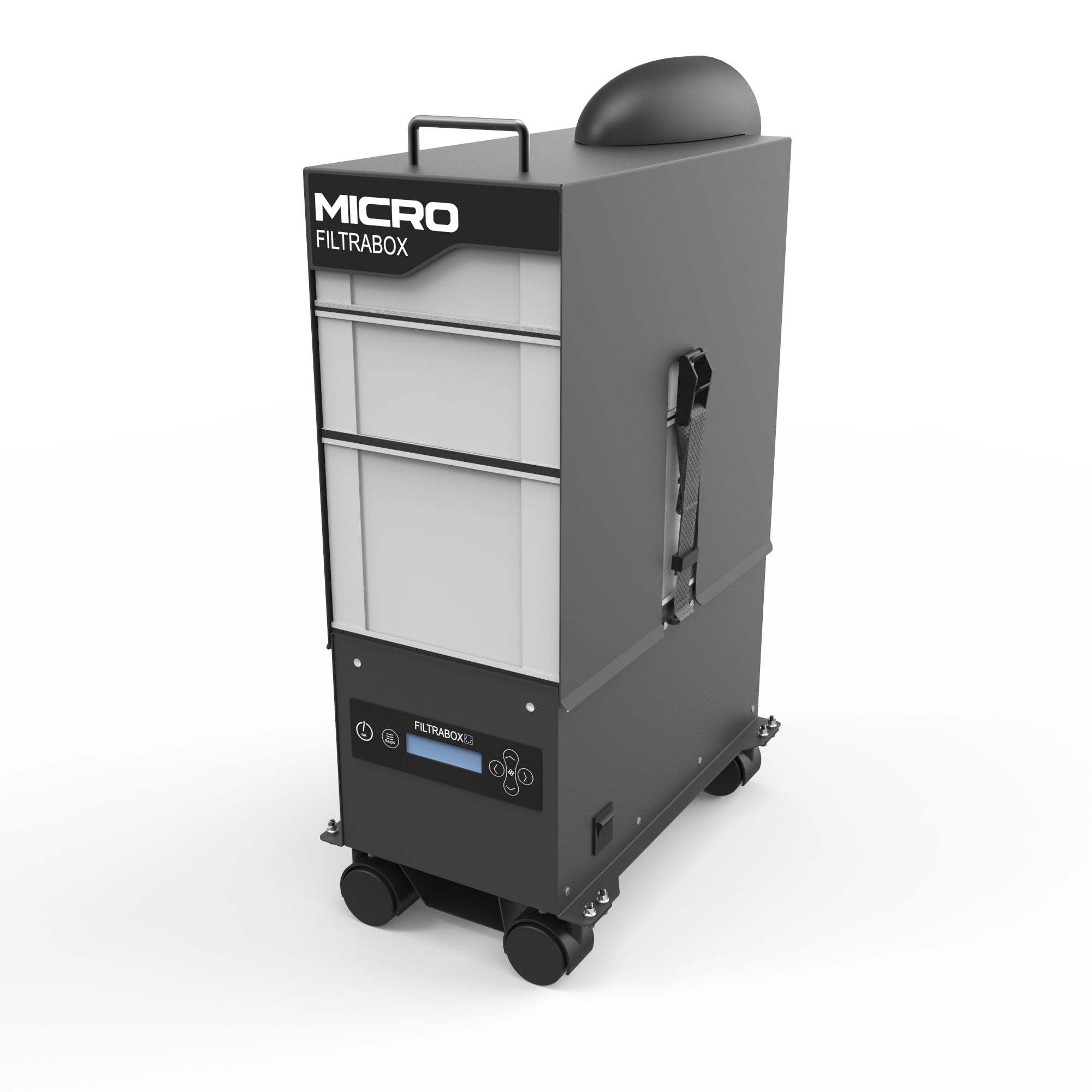
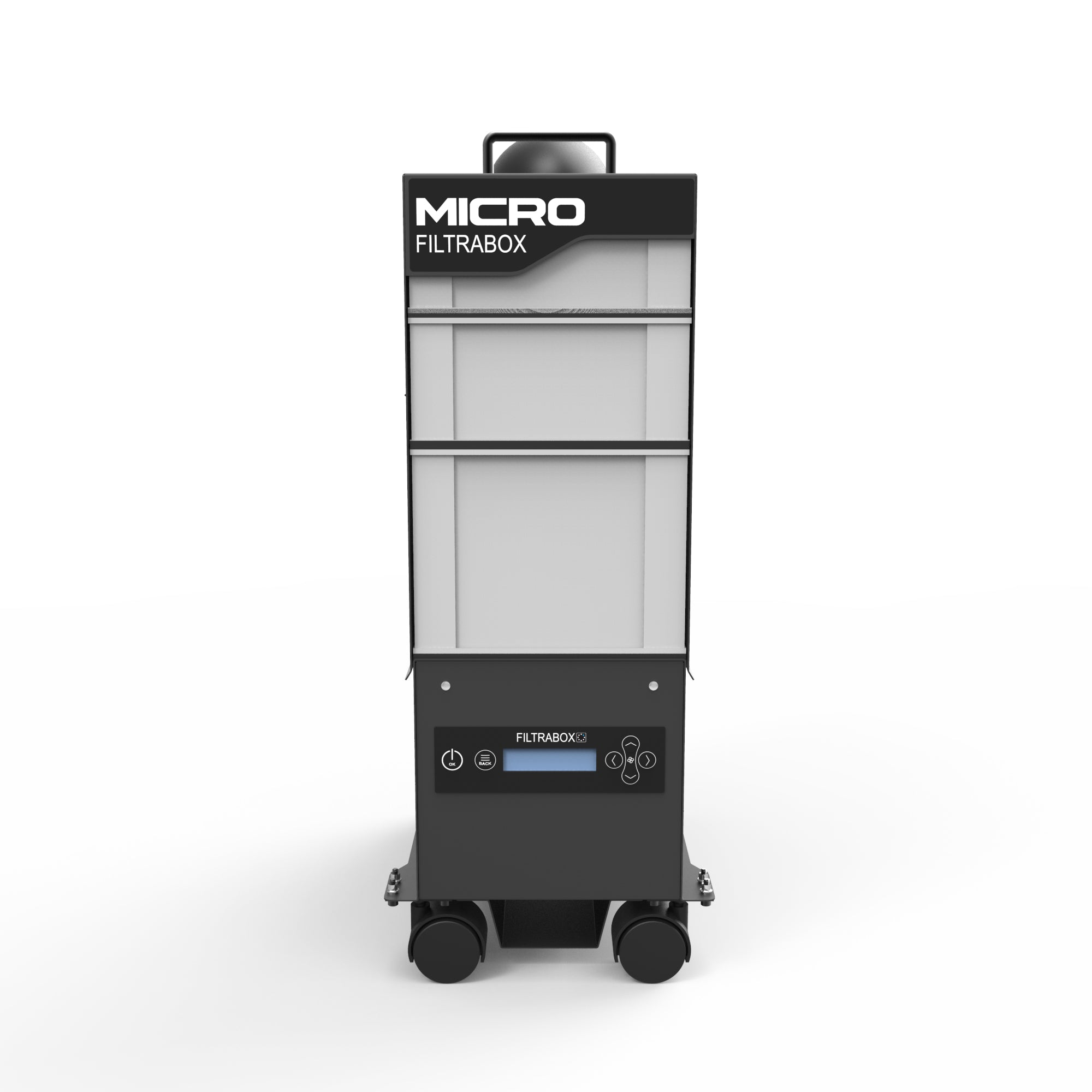
The Under-Desk Laser Fume Extractor With Professional Filtration in a 10-Inch-Wide Cabinet.
The Filtrabox Micro is a portable 3-stage laser fume extractor built specifically for hobby lasers, diode laser engravers, and small CO2 systems — with 99.999% HEPA filtration, 20 lbs of activated carbon gas media, and an intelligent flow regulator in a cabinet that's just 10 inches wide, 26 inches tall, and 17 inches deep. Designed to tuck underneath a work table or desk, it delivers genuine Filtrabox filtration performance in the smallest footprint the brand has ever produced.
Why Your Hobby Laser Actually Needs Proper Fume Extraction
Diode lasers and smaller CO2 engravers are often marketed without much discussion of the fumes they produce. But the physics don't change based on machine price: any laser processing organic material generates respirable submicron particles and VOC gases. Acrylic produces significant off-gassing. Leather produces aldehydes and other organic compounds. Wood produces particulate and terpenes. Painted metals produce metal oxide fumes.
Most hobbyists manage this with a window cracked open, a box fan, or a basic inline filter — none of which capture submicron particles or VOC gases at meaningful efficiency. The Filtrabox Micro exists because hobbyists and small shop owners deserve the same filtration standard as industrial operators, in a format and at a price point that makes sense for the machine they're running.
The Micro delivers excellent performance on hobby lasers and small industrial laser systems, extracting, filtering, and recirculating clean air into the workspace.
3-Stage Separated Filtration — The Complete System in the Smallest Cabinet
The Micro uses the same filtration architecture as every other Filtrabox system — three individually separated stages, each in a rigid aluminum cartridge, each performing a specific function.
Stage 1 — F9 Pre-Filter (3 m², Rigid Aluminum Cartridge): Removes the majority of submicron respirable dust before it reaches the HEPA stage, protecting the critical downstream HEPA filter from strain and premature clogging. Mini-pleat glass fiber media sized appropriately for hobby laser particle loads — enough surface area to handle the material without loading rapidly under normal use.
Stage 2 — HEPA H14 Filter (3 m², Rigid Aluminum Cartridge): Tested at 99.999% efficiency at 0.3 microns — removing 99.999% of the most aerodynamically penetrating particles, while smaller and larger particles are captured at even higher efficiency, resulting in extremely clean air free of respirable dust.
The rigid aluminum cartridge construction is just as important in the Micro as in the larger ExpandX units. Cardboard-cased filters flex and crumple under the negative pressure that builds as filters load, allowing contaminated air to bypass the filter. The aluminum box structure resists flex so rubber seals maintain contact with sealing surfaces throughout the filter lifecycle.
Stage 3 — Chemical Gas Filter (20 lbs Coconut Shell Carbon + KMnO4, Rigid Aluminum Cartridge): The blend of high-grade coconut-shell activated carbon and potassium permanganate removes the broadest spectrum of laser-generated VOC gases at the molecular level. At 20 lbs, the Micro's carbon load is scaled for smaller laser systems running hobby-level session volumes — genuine odor elimination during and after engraving on acrylic, leather, wood, and similar materials.
Why Separate Filters Are Worth It at Any Machine Size
Lasering acrylic produces 90% VOC gases and 10% dust. Lasering wood produces 10% gases and 90% dust. With individually separated filters, each filter can be replaced when it's actually spent — which varies with each material lasered.
Even for a hobbyist running a diode laser a few hours a week, this matters. If you primarily laser acrylic, your gas filter will exhaust well before your HEPA. If you mostly do wood engraving, it's the reverse. With a combined cartridge, you replace both stages when one is spent. With the Micro's separated design, you only replace what's actually exhausted — keeping the cost of ownership lower across the machine's life.
Intelligent Flow Regulator — Consistent Performance Maintained Automatically
As filters accumulate material over time, airflow resistance increases and extraction effectiveness decreases. Without compensation, a machine that performed well on day one is quietly underperforming by day 60 — and the operator often doesn't notice.
The intelligent flow regulator proportionally increases blower power to automatically overcome restrictions and maintain consistent fume extraction as filters load. Just enter your flow setpoint and Filtrabox does the rest. The system also alerts you when filters need changing — based on actual loading, not a guessed schedule.
For a hobby operator who isn't watching their extractor's performance closely between sessions, this automation is the feature that ensures protection stays consistent without requiring active management.
Designed to Disappear Into Your Workspace
Others try to achieve space savings by making smaller machines — but this results in less filter capacity, more noise, and less airflow. The slim-line design shrinks the width and relocates critical features into the depth dimension, allowing maximum airflow, filter capacity, and noise reduction with no compromises.
At 10 inches wide, 26 inches tall, and 17 inches deep, the Micro is specifically dimensioned to fit under a standard work desk or table. Slide it in, connect the top-mounted inlet hose to your laser's exhaust, plug in, and it disappears into the workspace — out of the way, out of sight, quietly doing its job.
The top-mounted air inlet ensures the hose doesn't consume lateral clearance beside the machine — it exits upward and stays out of the way of workspace movement.
At 55 dB, the Micro is quiet enough for home offices, spare bedrooms, and apartment workshops where a noisier extractor would be disruptive. It runs on 120V or 240V — standard household outlets in either configuration.
Modular Electronics for Simple Service
The Micro consolidates all components — interface, control, blower, and power systems — into a single removable Electronics Module. In the event of a field issue, a basic diagnosis identifies the module, which is dispatched immediately for replacement. No tech experience required.
For a hobby operator or small business owner, this means service is handled at home with a module swap — not by shipping the machine to a repair facility and waiting. The plug-and-play harness design means the replacement takes minutes.
The dustproof, splash-proof, impact-resistant membrane touchpad is built for real shop environments — resistant to the conditions that degrade unprotected control interfaces over time. The canted angle makes the display easy to read and the controls easy to actuate even when the unit is positioned under a desk.
The Maker's Chest Difference
The Filtrabox Micro is available from Filtrabox directly and through other distributors. Here's what changes when you order through The Maker's Chest:
- 🛡️ 75-day returns — significantly longer than most distributor windows. Enough time to install the Micro under your desk, run it through your actual laser and materials, and confirm it handles your specific setup before you're committed
- 🇺🇸 Expert USA-based technical support — our team can help with installation questions, filter selection guidance for your materials, and any issues that come up after delivery
- 📞 Dual lines of support — phone and email, so when you have a question, you have a direct path to a real person who knows this product
- 🔧 Straight sizing guidance — Micro or Compact X? Not sure which size is right for your hobby laser and how heavily you use it? Tell us your machine and usage pattern and we'll give you a direct recommendation before you order
Frequently Asked Questions
Q: What laser systems is the Filtrabox Micro designed for? A: Hobby lasers and small industrial laser systems — diode laser engravers like the xTool D1 Pro, Atomstack, Sculpfun, and similar, as well as small CO2 systems in the 20W–50W range running hobby-level to light production sessions. For larger CO2 machines, higher-wattage systems, or heavier daily use, the Compact X or ExpandX-1 is more appropriate. Contact our team with your laser model and usage pattern and we'll confirm the right fit.
Q: Does it fit under a standard desk? A: Yes — the Micro is specifically designed and dimensioned for under-desk installation. At 26 inches tall, 10 inches wide, and 17 inches deep, it fits comfortably under most standard work surfaces. The top-mounted inlet hose exits upward, keeping the connection clean and out of the way of workspace movement.
Q: Does it need to be ducted outside? A: No. The Micro extracts, filters, and recirculates clean air into the workspace. All three filtration stages process the extracted fumes and return clean air to the room — no wall penetrations, no exterior exhaust duct. This makes it appropriate for home offices, spare bedrooms, apartment workshops, and any space where running outdoor exhaust is impractical.
Q: How is the Micro different from the Compact X?
A: Both use the same 3-stage separated filtration approach and identical engineering principles. The Micro is smaller: 10" × 17" × 26" with 3 m² filter stages and 20 lbs of carbon, versus the Compact X's 15" × 21" × 29" with 6 m² filter stages and 40 lbs of carbon. The Micro is the right choice for hobby lasers, light use, and spaces where under-desk fit is the priority. The Compact X is appropriate for mid-sized laser systems and moderate daily production. If you're processing more than a couple of hours daily or running a 60W+ CO2 laser, the Compact X is the better fit.
Q: How long will the filters last?
A: Filter life depends on your materials and session frequency. The intelligent flow regulator monitors actual loading and alerts you when replacement is needed — so you're not guessing or replacing filters prematurely. The gas cartridge's lifespan varies most by material: acrylic-heavy sessions exhaust it faster than wood-dominated sessions. The pre-filter loads faster than the HEPA and will need changing more frequently.
Q: What power does it require?
A: 120V or 240V, auto-switching — 8A at 120V, 4A at 240V. Standard household outlets work in both configurations. No dedicated circuit required.
Q: Is it quiet enough for a home office or bedroom workshop?
A: At 55 dB, the Micro is quieter than most box fans and comparable to a normal office environment. It's suitable for home offices, bedroom workshops, and shared living spaces where a louder machine would be disruptive.
Q: Do I need a separate fume extractor if my laser has a built-in fan?
A: Yes, in most cases. Built-in laser fans create airflow that moves fumes away from the work area, but they don't filter — the fumes are simply exhausted elsewhere (usually into the room or through a window hose). The Filtrabox Micro captures submicron particles at 99.999% HEPA efficiency and removes VOC gases through the activated carbon stage — something a built-in fan cannot do. If you're laser engraving in an enclosed space and care about long-term air quality, a proper 3-stage extractor is the correct solution.
Q: Why buy from The Maker's Chest instead of directly from Filtrabox?
A: Our 75-day return window gives you real evaluation time in your actual workspace — significantly more than Filtrabox's direct policy. Our USA-based expert support team is reachable by phone and email for installation guidance, filter selection advice, and any questions during production. If the Micro isn't quite the right size for your setup, we'll work with you on the right configuration.
Filtrabox Micro Manual:
Click the links below to download product manuals for the Filtrabox Micro.
| Filtrabox Micro Product Manual |

|