

Last updated June 2026
Quick answer: UV lasers (355nm) win on precision — cold, non-thermal marking that’s unbeatable on plastics, glass, and delicate electronics. IR fiber lasers (1064nm) win on power and depth — the industry standard for engraving bare and coated metals fast and permanently. Most shops eventually want both; which one you buy first depends on what you’re marking most.

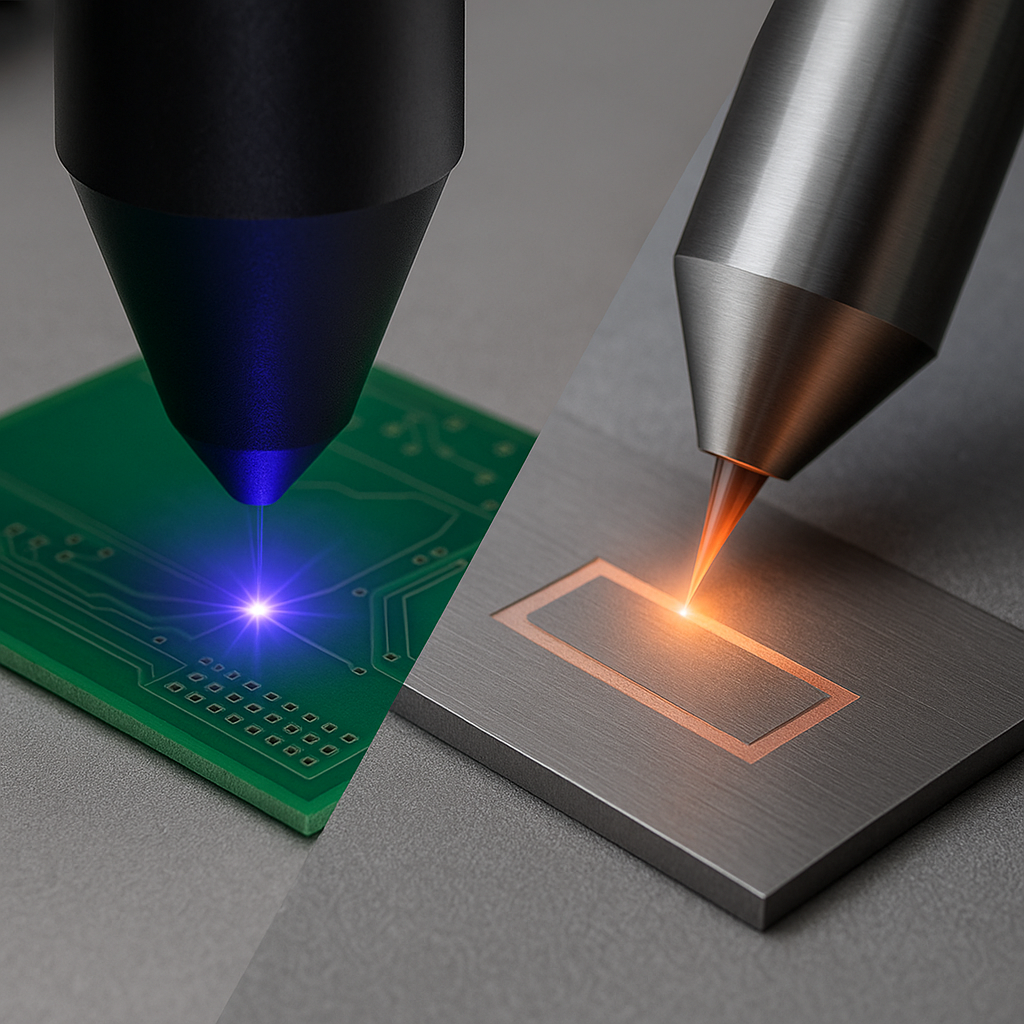
At the heart of the UV vs IR debate is a single factor: wavelength. A UV laser typically operates at 355 nanometers, part of the ultraviolet spectrum. Its shorter wavelength carries higher photon energy, so it interacts with the surface through photochemical reactions rather than brute heat — often called "cold marking."
An IR laser emits at 1064 nanometers, in the infrared range. This longer wavelength delivers lower photon energy but greater penetration power, reaching deeper into the material. In practice: UV lasers are surgical tools built for precision; IR lasers are industrial workhorses built for depth, speed, and endurance.
When laser light hits a surface, it’s reflected, absorbed, or transmitted — wavelength determines which dominates. UV light, with its short wavelength, is absorbed almost instantly at the surface, minimizing heat buildup. That’s why UV lasers produce clean, contrast-rich marks even on heat-sensitive materials like plastics or glass. IR lasers penetrate deeper, transferring energy through heat — fantastic for metals and durable materials, but capable of burns or discoloration on soft substrates.
UV lasers excel here. Photochemical reactions rather than thermal ones create clean, high-contrast marks without melting or warping plastic housings or medical casings. IR lasers, while powerful, often introduce unwanted burning or discoloration on plastics — UV remains the gold standard for delicate polymers.
IR lasers pass straight through transparent materials — great for cutting, not for marking. UV lasers are absorbed by the surface layer, making them capable of etching text, serial numbers, and patterns directly onto glass without cracking. This makes UV systems popular in electronics manufacturing, where display glass and optical lenses need fine, permanent identification.
For bare metals, IR fiber lasers are the clear winners — their longer wavelength is absorbed efficiently by stainless steel, aluminum, titanium, and brass, producing deep, dark marks with excellent contrast. UV lasers come into play with coated or anodized metals, where precision and surface quality matter more than depth — marking a matte-black aluminum housing requires the lighter touch UV provides.
UV lasers excel at finesse — intricate logos, QR codes, calibration markings that need to stay razor-sharp. IR lasers dominate where depth and durability matter most: serial numbers on metal tools, nameplates, and engine parts that need to survive heat, wear, and cleaning.
The smaller the laser spot, the finer the detail — and UV lasers hold a serious advantage here. Their shorter wavelength allows tighter focusing, producing micro-text, high-resolution logos, and even 3D microstructures. IR lasers have a slightly larger spot size, better suited for bold, legible markings meant to stand out from a distance, like machine plates or industrial tags.
UV lasers rely on non-thermal photochemical reactions, so they can engrave delicate surfaces like plastics or films without scorch marks or residue. IR lasers work with heat, which can create "heat-affected zones" where material melts or discolors slightly — fine for metals, riskier for softer materials.
For medical tools, circuit boards, or microchip components, there’s no room for error. UV lasers produce micro-scale engravings with accuracy measured in microns — manufacturers use them for invisible identifiers and anti-counterfeiting marks so small they’re only visible under a microscope. That level of detail isn’t achievable with IR systems.
IR lasers win the speed race, especially on metals — their deeper absorption means faster energy transfer for high-volume jobs. UV lasers, though slower, make up for it with unmatched accuracy. In industries where precision outweighs quantity — medical devices, electronics — speed takes a back seat to perfection.
UV laser systems are more complex to build and typically cost more upfront, but offer lower rework rates, minimal waste, and long-term savings through precision and reduced scrap. IR lasers are more affordable to purchase and maintain, and power-efficient — ideal for heavy industrial workflows where throughput matters more than microscopic detail.
Fiber IR lasers are known for exceptional longevity, often exceeding 100,000 working hours with minimal maintenance — rugged, sealed, and dust-resistant, well suited to factory environments. UV lasers need a bit more care since their internal optics are more sensitive; regular cleaning and alignment keep performance consistent. Both technologies are reliable — it’s a question of whether you value industrial endurance or precision stability more.
| Application | Best Choice | Why It Works |
|---|---|---|
| Plastic housings, circuit boards, medical casings | UV | Gentle surface marking, zero melting |
| Metal tags, aerospace tools, machinery | IR (Fiber) | Deep engraving with strong contrast |
| Glass components, crystal gifts | UV | Marks without cracks or stress fractures |
| Automotive or aerospace parts | IR | High-speed, permanent metal engraving |
| Branding & decorative etching | UV | Clean, detailed designs with smooth edges |
Many modern shops use both: UV handles the delicate work, IR handles bulk metal marking. UV lasers are common in electronics, semiconductors, medical manufacturing, luxury packaging, and product branding; IR lasers dominate automotive, aerospace, industrial tooling, and heavy manufacturing.
It depends on your primary material. If most of your work is plastics, glass, coated metals, or anything heat-sensitive, start with UV. If you’re marking bare metal — stainless steel, aluminum, titanium — an IR fiber laser is the better first purchase. Many growing shops eventually own both.
UV lasers can mark coated or anodized metals well, but they’re not the right tool for deep marking on bare, uncoated metal — that’s IR fiber territory. IR fiber lasers are absorbed far more efficiently by raw stainless steel, aluminum, and titanium, producing deeper, higher-contrast marks.
Not effectively. IR light largely passes through transparent materials like glass and quartz rather than being absorbed, which is why IR is used for cutting glass-adjacent materials but not for clean surface marking on glass itself. UV’s shorter wavelength is absorbed at the surface, which is what makes it capable of etching glass cleanly.
IR fiber lasers are generally faster, especially on metal, because their deeper energy absorption transfers heat more efficiently for high-volume jobs. UV lasers are slower but deliver finer detail and zero thermal damage — in precision-critical industries like medical devices and electronics, that trade-off is worth it.
UV lasers need a bit more care — their internal optics are more sensitive and benefit from regular cleaning and alignment. IR fiber lasers are known for exceptional longevity, often exceeding 100,000 working hours with minimal upkeep, making them the lower-maintenance option for heavy industrial use.
Not sure which laser type fits your work? Contact our team, or browse our UV Laser Engravers collection to see UV precision in action.

Shipping Insurance ($89)
placeholder

Leave a comment