

Last updated June 2026
Quick answer: Laser engraving is safe when you respect the risks — fire and fume hazards from burning material, eye damage from reflected beams, microfractures on brittle materials like glass, and real maintenance and competitive-market costs over time. None of these are reasons to avoid the craft; they're reasons to plan for ventilation, eye protection, and a maintenance budget from day one.

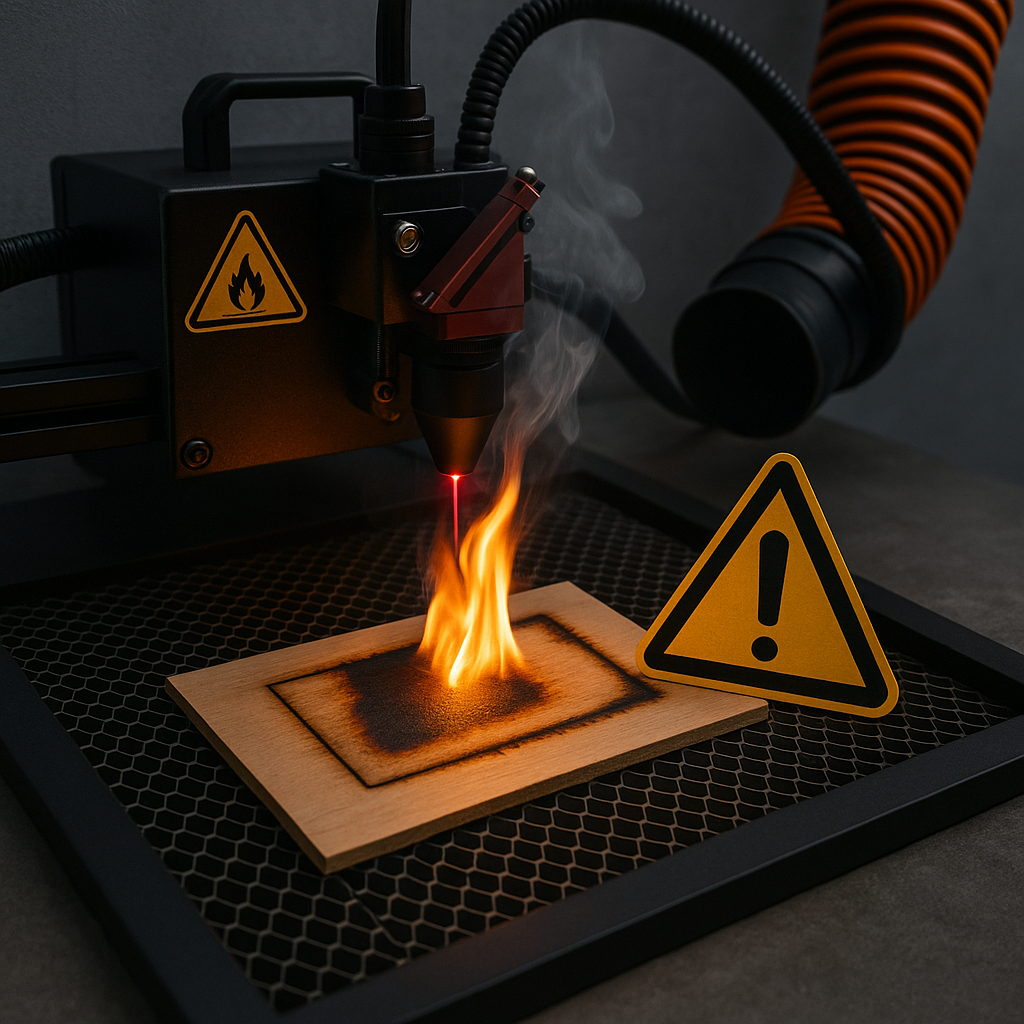
A laser engraver is, in effect, a tiny controlled fire machine. When that concentrated beam hits wood, leather, or acrylic, it's burning its way through the material — which means sparks, smoke, and occasionally small flare-ups. A job left running unattended can turn into scorched material or worse.
Based on our experience selling laser engravers to businesses and hobbyists of all sizes, fumes are the most underestimated risk. Acrylic smells like melted plastic, leather smells like a bonfire, and certain plastics — PVC in particular — release toxic chlorine gas when engraved. Breathing that in isn't just unpleasant, it's a genuine health risk. Proper ventilation, fans, or a dedicated fume extractor aren't optional accessories; they're essential, especially in a home studio or any space where the operator works for hours at a stretch.
Lasers don't look intimidating, but they can cause irreversible eye damage in seconds. Even a reflected beam bouncing off a polished surface can do real harm — plenty of engravers only realize this risk after accidentally damaging a lens with reflected light, a mistake that could just as easily have been their eyes.
Safety glasses rated for your specific laser's wavelength are non-negotiable. Some operators install tinted shields around their machines for extra protection. A $30 pair of rated glasses is arguably the best return on investment in your entire setup — it protects something a replacement laser tube never can.
Engraving mirrors and untreated glass sounds straightforward until you try it — the beam often bounces unpredictably, damaging the machine or creating patchy, inconsistent results. Experienced engravers work around this by engraving the backside of coated glass or using a marking spray to reduce reflectivity. Beautiful results are possible, but it's a trickier learning curve than wood or acrylic.
Materials don't always cooperate. Wood can scorch along the edges, leaving blackened marks that need sanding or sealing. Leather may curl or warp under heat. Stone or glass can develop microfractures — tiny cracks that aren't obvious at first but weaken the structure, which is exactly how an engraved glass award ends up cracking when the recipient picks it up. Careful calibration — adjusting speed, power, and always test-running on scrap before the final piece — is the way to reduce these risks.
Fixed-focus systems require you to manually measure and set the laser height for each job — time-consuming, and it introduces human error. Forget to adjust, and the design comes out blurry or shallow. Auto-focus systems solve a lot of this by adjusting automatically based on material thickness, but they're not perfect — transparent or warped materials can trick the sensor, and curved surfaces like rings often still require manual settings.
Laser engravers don't run forever without attention. CO2 tubes wear out, usually every 1–3 years, and replacements can cost several hundred dollars. Mirrors, lenses, and belts all need regular cleaning and eventual replacement — skip maintenance, and crisp engravings quickly turn into fuzzy disappointments. Fiber lasers last longer, often tens of thousands of hours, but when something does fail, it's rarely a $200 fix — it can run into the thousands. Treat maintenance like a non-negotiable business cost, not an afterthought.

Laser engraving is popular, which means everyone wants a piece of it. Etsy is full of sellers pumping out personalized items, and overseas manufacturers flood the market with cheap alternatives. Customers see a $20 cutting board and wonder why yours costs $50. Competing on price alone is a losing battle — a solo engraver can't undercut mass producers with bulk materials and factory-scale efficiency.
The businesses that thrive don't try to be the cheapest — they carve out a niche. Heirloom-quality woodwork, luxury corporate gifts, ultra-fast local turnaround. By leaning into areas where mass producers can't compete, price becomes less important than value. A wedding-décor business built around fully personalized packages — signs, glassware, favors, delivered within weeks — charges premium prices because brides aren't shopping for the cheapest option; they're shopping for trust, service, and a memorable product.
Yes, with the right precautions. You need proper ventilation or a fume extractor (especially for plastics and PVC, which release toxic fumes), laser-rated safety glasses, and a machine you never leave running unattended. Many hobbyists and small business owners run laser engravers safely from home studios by treating these as non-negotiable setup requirements, not optional extras.
PVC is the most commonly flagged material — it releases toxic chlorine gas when cut or engraved with a laser and should be avoided entirely. Other materials that produce concerning fumes include certain treated woods, some painted or coated metals, and any material you can't positively identify. When in doubt about a material's composition, don't engrave it until you've confirmed it's laser-safe.
Yes, even briefly. A direct or reflected beam can cause irreversible eye damage in seconds, and reflections off polished or metallic surfaces are a common and underestimated risk. Laser-rated safety glasses matched to your machine's wavelength should be worn any time the laser is in operation, not just during setup.
CO2 laser tubes typically need replacement every 1–3 years depending on usage, at a cost of several hundred dollars. Lenses and mirrors need regular cleaning — ideally weekly with regular use — and belts and rails need periodic inspection. Fiber lasers last considerably longer, often tens of thousands of hours, but repairs when needed tend to be more expensive. Budgeting for maintenance as an ongoing cost, rather than reacting to failures, keeps a business running smoothly.
Yes, but not by competing purely on price against mass producers and overseas sellers. Businesses that succeed find a defensible niche — a specific material, a premium finish, faster turnaround, or a market segment (weddings, corporate gifts, a specific hobby community) where customers value service and quality over the lowest price. Price-only competition is a losing strategy against factory-scale operations; differentiated positioning isn't.
Thinking about getting started or scaling up? Contact our team and we'll help you choose a setup that fits your space, budget, and safety needs.

Shipping Insurance ($89)
placeholder

Leave a comment