

Last updated June 2026
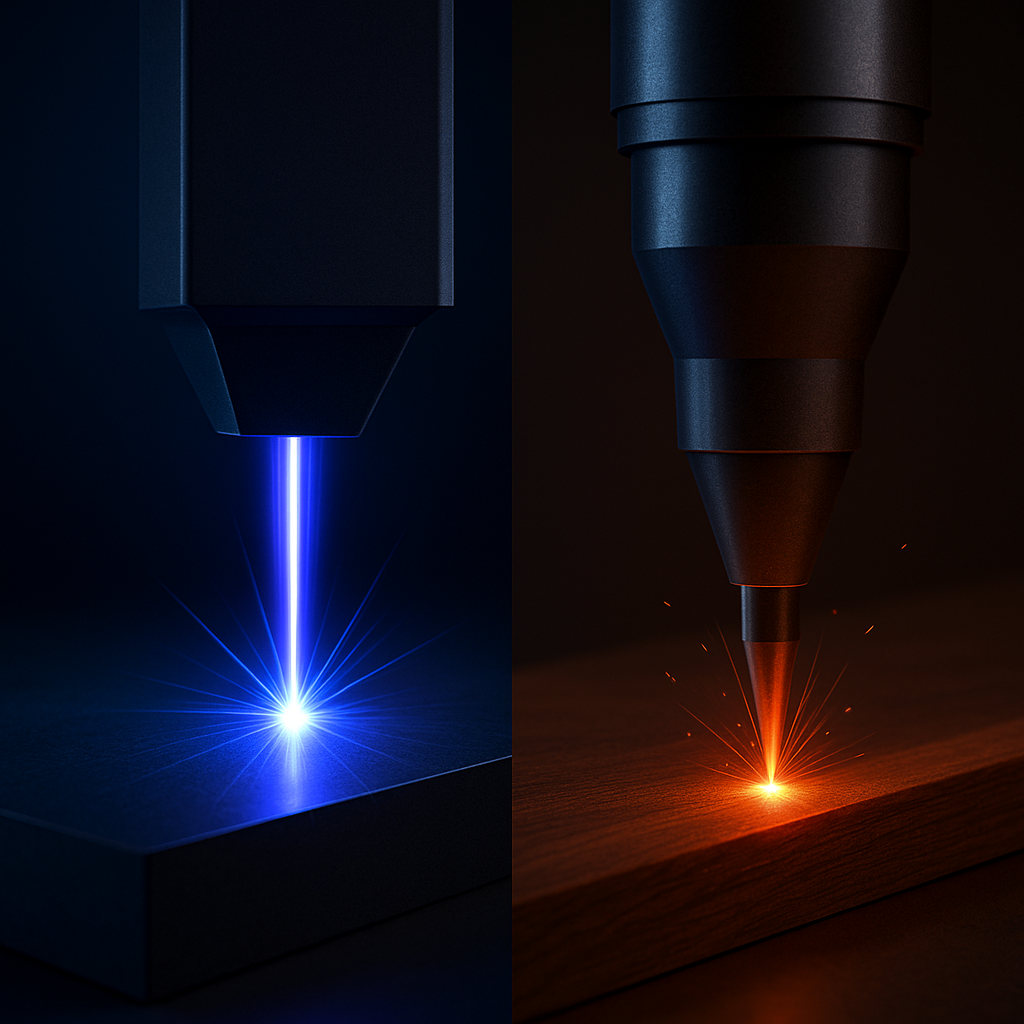
Quick answer: UV lasers (355nm, cold marking) win on precision, glass, plastics, and coated metals. CO2 lasers (10.6 micrometer, thermal marking) win on speed, affordability, and cutting power through organic materials like wood, leather, and acrylic. Most makers eventually want both — UV for delicate detail work, CO2 for bulk cutting and engraving.

UV lasers operate in the ultraviolet range, around 355 nanometers, created by converting a standard infrared laser through a process called frequency tripling. That shorter wavelength means UV lasers focus tighter and interact with materials at the surface rather than heating the whole structure.
CO2 lasers live in the infrared zone at 10.6 micrometers. Their beam comes from a gas mixture — carbon dioxide, nitrogen, and helium — excited by an electric current, producing a long-wavelength beam capable of burning, cutting, and vaporizing thicker materials. It's the difference between surgical precision and raw industrial strength.
UV light is absorbed almost instantly by most materials — plastics, ceramics, metals, even glass — because its high photon energy breaks molecular bonds directly. This is "cold marking": almost no heat, no burning, no damage to nearby material, which is exactly what you want on a medical syringe or jewelry tag.
CO2 lasers work best when absorbed by organic materials rich in carbon — wood, leather, paper. They use thermal marking, heating the surface until it vaporizes. It's fast and powerful but introduces a heat-affected zone (HAZ); fine for organic materials, but it can mean warping or discoloration on sensitive or reflective surfaces.
UV lasers handle inorganic materials — glass, ceramics, metals — with microscopic control, producing crystal-clear etching and razor-thin lines. CO2 lasers are built for organic materials like wood, leather, or textiles, burning cleanly and leaving dark contrast ideal for signage, decor, and custom packaging.
UV lasers can mark coated, anodized, or painted metals without damaging the layer underneath — which is why electronics, aerospace, and medical manufacturing rely on them. CO2 lasers struggle with bare or polished metals since infrared light tends to reflect off them; a metal marking spray can help, but it's an extra step that adds time and cost.
CO2 wavelengths pass straight through transparent materials, so a CO2 laser does nothing on clear acrylic or glass. UV lasers can engrave and etch clear surfaces like glass or crystal with pinpoint precision — no cracking, no frosting — making them the go-to for glass trophies, mirrors, and luxury packaging.
CO2 laser jobs often show slightly burned or browned edges, a hallmark for makers who love that contrast — but that same heat can cause charring, especially on light-colored materials. UV lasers eliminate this issue entirely: no carbonization, no smoke marks, no post-processing required, which is why they're common for high-end branding and medical-grade labeling.
UV lasers take the crown on detail. Their tiny spot size (10–20 microns) allows micro-text, intricate barcodes, and detailed logos small enough to fit on a grain of rice. CO2 lasers, while less precise, are unbeatable when size and speed matter — cutting through ¼-inch wood or acrylic sheets with ease.
CO2 lasers on brittle materials like glass can cause microcracks from sudden temperature changes. UV lasers, with their cold processing, bypass that issue entirely — smooth, damage-free marks that look factory-perfect even under a microscope.
UV lasers excel at shallow, consistent markings — serial numbers, microchips, medical labels. CO2 lasers are built for depth, ideal for engraving into wood, leather, or rubber stamps. For production batches, UV's stability ensures identical results every time, while CO2's power lets you scale quickly on thicker materials.
When speed is everything — cutting dozens of acrylic panels, for example — CO2 lasers are the better bet. Their high wattage and fast scanning speeds make quick work of large jobs. UV lasers move slower, but every pass is precise and clean — if consistent, flawless micro-detailing is the goal, UV's pace is a fair trade.
CO2 lasers tend to run hotter and often rely on water-cooling systems. UV lasers, being diode-pumped and more compact, are air-cooled and consume less power, translating to lower long-term operating costs and fewer interruptions.
A CO2 laser is generally cheaper to buy, maintain, and replace parts for — it's a dependable, cost-effective workhorse. A UV laser, though more expensive upfront, pays for itself in precision, low waste, and high-quality output. An electronics manufacturer using UV can avoid rejects from heat damage, saving materials over time — an ROI that easily justifies the initial price for the right application.
Many modern workshops use both: a UV laser handles delicate work — intricate marks, logos, micro details — while a CO2 laser powers through bulk cutting and large engravings. It's the best of both worlds: speed and strength from CO2, precision and finesse from UV.
Not well on bare or polished metal — infrared light tends to reflect off it. A metal marking spray can help a CO2 laser produce a visible mark, but it's an extra step. For real metal engraving, a fiber laser is the right tool; for coated or anodized metals specifically, UV lasers handle it cleanly without that extra spray step.
CO2 wavelengths largely pass straight through transparent materials rather than being absorbed at the surface, so the laser doesn't interact with the material the way it needs to for engraving. UV lasers are absorbed right at the surface, which is exactly what makes them capable of crisp, crack-free engraving on glass and clear acrylic.
CO2 lasers are generally cheaper to purchase, maintain, and run — they're the more accessible workhorse option. UV lasers cost more upfront but reduce rework and waste on precision jobs, which can offset the higher initial cost over time for businesses doing detail-critical work.
UV lasers can mark and lightly engrave wood, but they're not built for cutting through it — that's squarely a CO2 laser's job. CO2's thermal, higher-power beam is what makes it effective for cutting wood, leather, and acrylic; UV is the better choice when you want fine surface detail without burn marks.
Many growing shops end up with both, because they solve different problems. A CO2 laser covers fast cutting and engraving on wood, leather, and acrylic at a lower cost. A UV laser covers the jobs CO2 can't touch well — glass, clear plastics, coated metals, and fine detail work. If you're starting out, choose based on which material category makes up most of your current work.
Not sure which laser fits your shop? Contact our team, or browse our UV Laser Engravers collection for precision-built options.

Shipping Insurance ($89)
placeholder

Leave a comment