

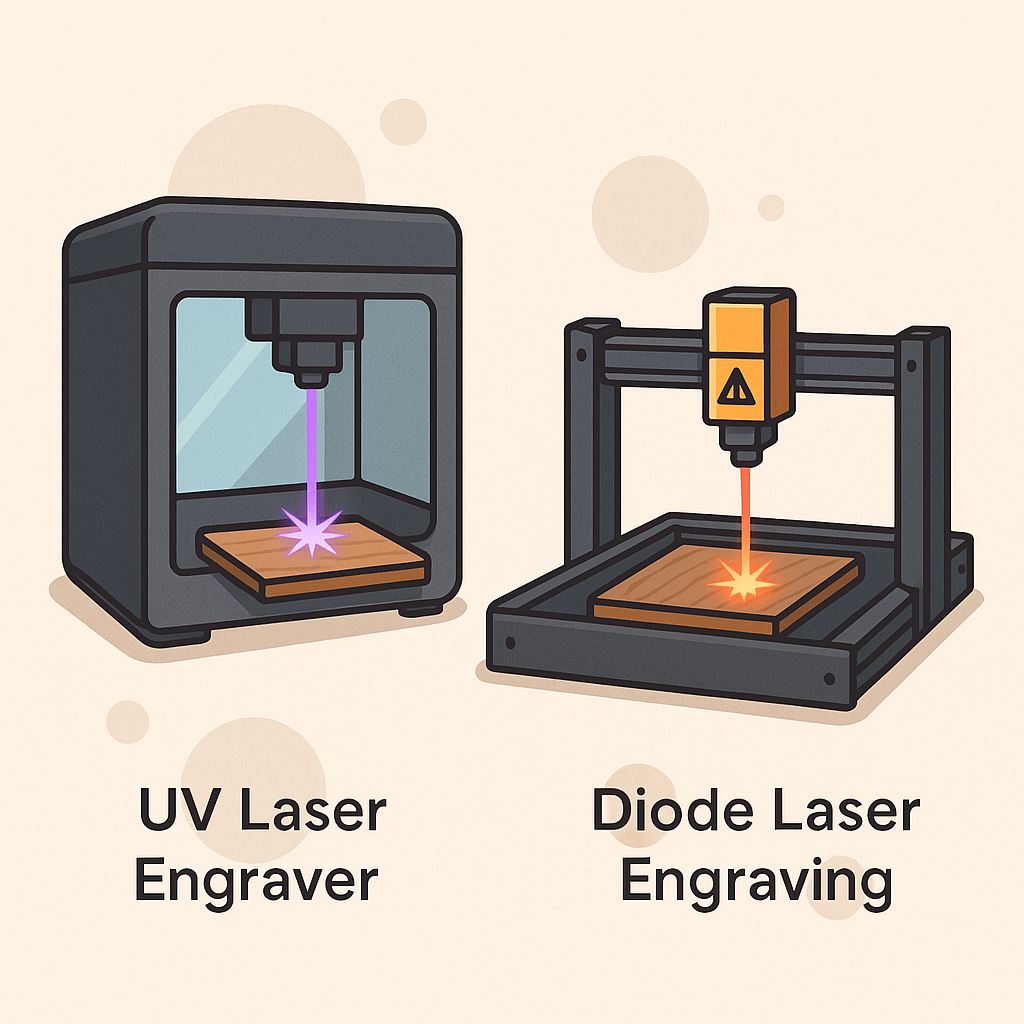
Last updated June 2026
Quick answer: UV lasers win for precision and delicate materials — glass, plastics, electronics, fine jewelry. Diode lasers win for affordability and versatility on wood, leather, and coated metals. A diode laser costs $200–$1,000; a UV laser starts around $3,000 and can exceed $10,000 for industrial-grade units. The right choice depends on your materials and budget, not which one is "better" in the abstract.

A UV laser engraver uses cold laser technology — short ultraviolet wavelengths that break molecular bonds directly at the surface, like carving with a scalpel instead of a branding iron. A diode laser is a heat-based system, using visible or infrared light (typically blue or near-infrared) to heat and vaporize the surface. That makes diode lasers excellent for wood, leather, and coated metals — materials that respond well to controlled heat — but not ideal for plastics, glass, or anything that can warp or discolor.
UV lasers usually operate around 355nm, in the ultraviolet range. That shorter wavelength causes photoablation — vaporizing matter without heat damage. Diode lasers run between 450nm and 1064nm depending on the module; longer wavelengths penetrate deeper but bring heat along for the ride. That's why a UV laser can etch micro-text onto a contact lens while a diode laser is busy engraving a leather wallet — both impressive, very different strengths.
What sets UV lasers apart is their ability to engrave heat-sensitive materials — glass, acrylic, ABS plastic, even silicon chips — without relying on heat. No burned edges, no residue, no sanding or polishing required afterward. This makes them indispensable in medical manufacturing, electronics, and fine jewelry, where precision is everything.
UV lasers excel here, with beam sizes as small as 10–15 microns, enabling intricate text, sharp barcodes, and hairline-precise artwork. Diode lasers generally produce a wider beam, anywhere from 50–100 microns — plenty for hobbyist engraving, but not ideal for projects demanding ultra-sharp detail.
UV lasers handle both coated and bare metals — stainless steel, aluminum, brass — marking serial codes or logos with sharp contrast. Diode lasers typically need a marking spray or coating to produce visible results on metal; they can mark, but not truly engrave it.
Plastics are prone to warping and melting under heat, but UV lasers sidestep that entirely, producing smooth, uniform marks without deformation. Diode lasers work on certain coated or painted plastics but struggle with transparency or heat-sensitive blends. Glass and ceramics are notoriously tricky — prone to cracking and uneven heat absorption — and UV lasers handle them with flawless, frosted finishes; diode lasers can engrave glass in some cases (with coating or masking), but the risk of cracks and inconsistent texture is high.
A diode laser can cut and etch soft materials at impressive speeds, ideal for production runs on wood or coated metal. A UV laser may move slower in some settings, but every pass is precise and clean, allowing deeper, more controlled engraving for product identification or fine art. If visual quality matters more than raw pace, UV wins; if speed and cost-efficiency drive your work, diode takes the lead.
A diode laser can cost as little as $200–$1,000, perfect for beginners, small shops, or anyone testing the waters. A UV laser typically starts around $3,000 and can exceed $10,000+ for industrial-grade units — but what you're paying for is precision, repeatability, and durability. Many businesses offset that cost by offering specialized engraving (medical tools, high-end branding, electronics marking) where UV lasers command higher margins.
UV lasers need a bit of pampering — precision optics that must stay clean and calibrated, and they thrive in dust-free environments. Diode lasers are far more forgiving, with simple, sealed modules and easy lens cleaning. A UV laser typically lasts 10,000–20,000 hours, maintaining beam stability almost to the end; a diode laser usually averages 5,000–10,000 hours, with brightness gradually fading. For casual use, diode lifespan is more than enough; for commercial work, UV's longevity and consistency make it the smarter long-term investment.
If you need fine, permanent, professional-quality engraving, UV is the go-to. Industries like electronics, medical devices, automotive parts, and luxury goods rely on UV lasers for marking everything from circuit boards to perfume bottles. They're also strong for branding or personalization businesses working with mixed materials — jewelry, promotional items, glassware.
If you're just starting out or mainly engraving wood, leather, or coated metals, a diode laser is a fantastic choice — portable, affordable, and surprisingly capable for hobbyists, Etsy shop owners, or small makers. They're also easier to use in shared spaces or home studios.
Some modern systems combine UV, IR, and diode lasers into one body, letting you swap wavelengths for different materials. They're pricier but offer unmatched flexibility — worth considering if your workflow involves both delicate and rugged materials.
Precision, consistency, and versatility across materials are non-negotiable. It's the professional's pick for industries requiring perfect detailing, long-term reliability, and zero surface damage.
You want something practical, portable, and budget-friendly for everyday projects — an excellent starting point with room to grow.
A luxury jeweler might use a UV laser to micro-engrave hallmarks on 18k gold; a wood craftsman might rely on a diode laser to personalize 200 cutting boards a day; a tech manufacturer might use UV engraving to label polymer components without melting them. Different lasers, different strengths, same goal: precision craftsmanship.
Diode lasers typically need a marking spray or coating to produce a visible mark on metal — they can mark, but not truly engrave bare metal the way a UV or fiber laser can. For coated or anodized metal, results are decent; for bare stainless steel or aluminum, a UV or fiber laser is the better tool.
It depends on your materials and business model. If you regularly work with plastics, glass, electronics, or fine jewelry where heat damage is a dealbreaker, the UV laser's precision and lack of thermal damage justify the higher price — especially if you can charge a premium for that precision work. If your main materials are wood, leather, and coated metals, a diode laser delivers excellent results at a fraction of the cost.
Diode lasers are heat-based, and glass is highly prone to cracking and uneven heat absorption under thermal stress. Some diode setups can mark glass with coating or masking, but the risk of cracks and inconsistent texture is high. UV lasers use a cold, photochemical process that avoids this thermal shock entirely, which is why they're the standard choice for glass engraving.
Diode lasers generally cut and etch soft materials like wood and coated metal faster than UV lasers, making them well suited to high-volume production runs on those materials. UV lasers move more deliberately, but the trade-off is precision — cleaner, more controlled engraving, particularly valuable for fine art or product identification work.
Yes — combo systems that let you swap laser modules or wavelengths genuinely expand what a single machine can do, covering both delicate and rugged materials in one setup. They cost more than a single-purpose machine, but for a shop whose work spans both categories, the flexibility can be worth the premium over buying two separate machines.
Not sure which laser fits your shop? Contact our team, or browse our UV Laser Engravers collection for precision-built options.

Shipping Insurance ($89)
placeholder

Leave a comment