


Last updated June 2026
Quick answer: Yes, for the right buyer. The laser engraving market is valued at $3.84 billion in 2025 and projected to reach $6.41 billion by 2032, machine prices have never been lower for the capability you get, and most small business owners recoup their investment in 3–12 months by focusing on high-margin products. It’s not passive income — it takes time, skill, and proper setup — but the fundamentals are strong.

The demand for personalized products isn’t slowing down — it’s accelerating. The global laser engraving machine market is valued at $3.84 billion in 2025 and is expected to reach $6.41 billion by 2032, growing at a compound annual rate of 7.6%, driven largely by consumer appetite for customized gifts, branded merchandise, and one-of-a-kind products — exactly the space small businesses and independent makers occupy.
At the same time, machine prices have never been more accessible. A capable diode laser that would have cost $1,500 four years ago now runs under $700. Mid-range CO2 machines that used to sit at $4,000+ are now in the $2,000–$2,500 range for comparable specs. You’re getting more machine for less money than at any point in the technology’s history.
Take a $2,000 CO2 machine. A custom engraved cutting board might cost $8 in materials and 20 minutes of machine time. Sell it for $45–$55, and you’re clearing $35–$45 profit per unit. Sell 60 of those over a few months and the machine has paid for itself. Corporate and bulk orders accelerate ROI dramatically — a single order of 100 engraved tumblers for a company event could represent $1,500–$2,000 in revenue. Many small shop owners report recouping their machine investment within 3–12 months when they stay focused on high-demand products and price their work correctly. Profit margins in this space are genuinely strong: custom engraving businesses regularly report 50–70% margins on personalized items, since the emotional and perceived value of custom products far exceeds material cost.
Most people start small — a few tumblers for friends, signs for a craft fair, gifts around the holidays — then something clicks and orders become consistent. The key is transitioning from one-off orders to repeatable systems: batching similar jobs, standardizing bestselling designs, and building a catalog people can order from easily. Customization commands a premium that mass-produced products simply can’t compete with.
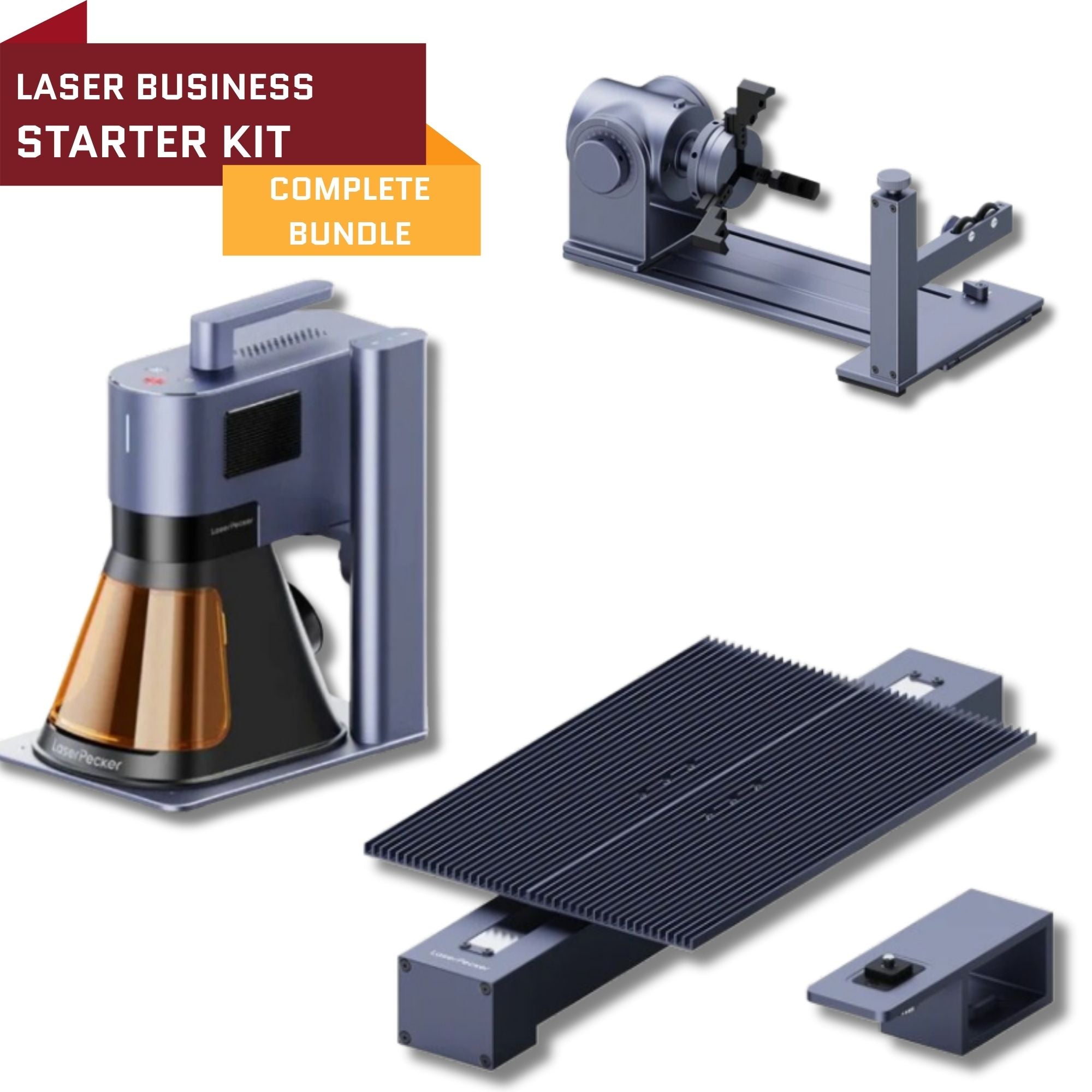
A portable, professional laser engraving system designed to help entrepreneurs launch a laser engraving business quickly.
View Full Product DetailsA compact diode laser can sit on a workbench, but a mid-size CO2 machine takes up a dining-table-sized footprint — plus exhaust, a rotary attachment, and material storage. Ventilation is non-negotiable: laser cutting produces smoke and fumes, and some materials (PVC most importantly) should never be cut with a laser due to toxic gases. Most home operators run a dedicated inline exhaust fan or a filtration unit for fully enclosed spaces. A $1,200 laser plus $300 in ventilation and $150 in accessories is closer to the real cost of getting started properly.
Modern engravers are far more beginner-friendly than five years ago, and software like LightBurn has extensive tutorials and an active community. Still, expect to run test pieces, waste some materials, and spend a few weeks learning before your first paid job looks exactly right. Establish safety habits early: never leave a running machine unattended, keep a fire extinguisher within reach, and check your exhaust system before every session.
Look for CE marking or FDA registration. Enclosed housing matters — open-frame diode lasers require safety goggles and pose more risk if something goes wrong. Emergency stop buttons and lid safety sensors that cut power when opened all contribute to a safer working environment. Evaluate safety features as a core spec, not an afterthought.
When you own the machine, you own the outcome — you can tweak a design at 10pm and run the job by morning, perfect settings through multiple test passes, and take a rush order outsourcing couldn’t fill. That speed and control builds the reputation and repeat business that sustains a small shop. Outsourcing still has its place for people testing whether engraving is right for them or running very low order volumes — if you’re under 10–15 jobs per month, the math may favor outsourcing for now. A practical middle ground: outsource a handful of orders to validate demand, then buy the machine that matches what you’ve learned about your realistic order volume.
A quality 10W–20W diode laser engraves wood, leather, slate, anodized aluminum, and painted surfaces well, and can cut thin materials like balsa wood and craft plywood. What it can’t do well: cut clear acrylic, engrave glass directly, or handle thicker materials at production speeds. If your lineup is wood coasters, leather goods, or painted tumblers, a diode can absolutely support a real business while you build your customer base.
For most small businesses serious about consistent revenue, a CO2 laser is the workhorse — cutting and engraving acrylic cleanly, working beautifully on wood, and handling glass, fabric, leather, and stone at real production speeds. A 40W–60W machine in the $2,000–$3,500 range is where most growing engraving businesses land.
Fiber lasers are built for metal — stainless steel, brass, aluminum, gold, silver — with hairline precision and permanent depth, no coatings required. If your niche is jewelry, knife making, industrial parts, or firearms accessories, the fiber laser is the right tool, not a luxury upgrade.
Many successful engravers start with a diode laser, build revenue, then reinvest profits into a mid-range CO2 machine, eventually adding a fiber laser for metal work. This limits upfront risk and means every upgrade is funded by the machine before it. Others skip straight to CO2 if they have a clear product direction and enough capital — your machine choice should follow your business goals, not the other way around.
Accessories: A rotary attachment ($60–$150), honeycomb bed ($40–$80), and air assist ($50–$200) aren’t optional extras for a production environment — they’re necessities.
Ventilation: An inline duct fan and ducting typically run $100–$200; a filtration unit for enclosed setups costs $300–$600.
Software: LightBurn is the industry standard for CO2 and diode lasers, around $60 for a one-time license. Fiber machines typically use EZCAD, usually included.
Materials for testing: Budget $100–$200 for test materials before your first paying job — that’s training, not failure.
Consumables: Lenses and mirrors need periodic replacement, and a CO2 laser tube has a finite lifespan (typically 8,000–10,000 hours). Budget $200–$500 per year for ongoing consumables.
Add it up and your true startup cost for a mid-range setup might be $2,500–$3,500 rather than the $2,000 machine price alone — still a very reasonable investment given the revenue potential.
For the right person in the right situation — yes, without question. The machines are better, cheaper, and more capable than ever. Demand for personalized products is growing consistently, the margin potential is real, and the barriers to entry are lower than at any previous point in the technology’s history. It isn’t passive income — it requires your time, skill, and attention to quality — but for makers willing to put in that work, the return is very much there.
For most small business owners focused on high-demand products, the breakeven point falls between 3 and 12 months, depending heavily on product selection and pricing. Items with strong margins — cutting boards, custom tumblers, personalized signs — can recover a $2,000 machine cost with 60–80 units sold. Bulk corporate orders dramatically accelerate this.
Yes, with proper ventilation planned in before your first job. With that in place, a home-based laser engraving business is completely viable and low-overhead compared to many other small business models.
For most people starting out, a mid-range CO2 laser in the 40W–60W range hits the sweet spot of capability, versatility, and price. If budget is tight, a quality 10W–20W diode laser can genuinely support a real business for wood, leather, and painted metal products.
Custom tumblers, personalized cutting boards, engraved ornaments (especially at Christmas), custom signage, and wedding or event accessories consistently perform well. Corporate orders — awards, branded merchandise, event giveaways — can be extremely lucrative because they’re bulk, less price-sensitive, and often repeat.
Budget $1,500–$4,000 for a realistic mid-range setup including the machine, ventilation, essential accessories, software, and initial testing materials. A diode laser setup can come in at $800–$1,500 all-in for a more modest start.
The fundamentals remain strong — demand for personalized products continues to grow, and market projections consistently show 7–9% annual growth through the end of the decade. The businesses that struggle compete on price alone; the ones that thrive compete on quality, turnaround time, and the experience of getting something made just for them.
Thinking about taking the leap? Contact our team and we’ll help you pick the right starter machine for your budget and product line.

Shipping Insurance ($89)
placeholder

Leave a comment