


Last updated June 2026
Quick answer: A profitable laser engraving business is built on three things done right: choosing products with strong margins (50–70% is achievable), pricing your work correctly from day one, and finding a niche narrow enough to own. The machinery is the easy part. Most businesses that struggle do so because of pricing mistakes, lack of niche focus, or trying to compete on price against mass producers. This guide covers the strategy, numbers, and realities in full.

The global laser engraving machine market is valued at $3.84 billion in 2025 and projected to reach $6.41 billion by 2032, growing at a compound annual rate of 7.6%. That growth is driven by one persistent consumer trend: people want personalised, meaningful products that chain stores can’t provide.
For small business owners, that’s an enormous structural advantage. A factory in Shenzhen can make 10,000 identical tumblers cheaper than you ever could — but it can’t engrave someone’s dog’s name on one and ship it in two days. That gap between mass production and meaningful personalisation is where laser engraving businesses thrive.
The entry barriers are also genuinely low. A mid-range CO2 laser, proper ventilation, and LightBurn software can get you operational for $2,500–$4,000. Compare that to almost any other product-based business with comparable margin potential, and laser engraving stands out as one of the most capital-efficient ways to build a physical goods business from scratch.
Based on our experience selling laser engravers to businesses of all sizes, the operators who succeed aren’t necessarily the most skilled at day one — they’re the ones who treat it as a business from the start, not a hobby that happens to generate revenue.
Equipment choice should follow your product direction, not the other way around. The most common and costly mistake new operators make is buying a machine before deciding what they’re going to sell.
A 40W–60W CO2 laser is the right starting point for most personalisation and gift-focused businesses. It handles wood, acrylic, leather, glass, slate, and fabric with excellent results, and runs at speeds that support real production volume. The FLUX Beamo 30W ($1,690) is an excellent entry point; the FLUX Beambox II 55W ($3,290) is the step up for businesses ready to scale throughput and handle larger formats.
If your business model involves bare metal — jewellery, tumblers, firearms accessories, industrial parts — a fiber laser is not a luxury, it’s a requirement. Standard fiber lasers handle most metal marking work well. MOPA fiber lasers add pulse-width control, enabling colour annealing on stainless steel, finer textures, and cleaner results on coated surfaces. The ComMarker Titan 1 MOPA is a strong entry point; the Haotian JPT MOPA 60W is the workhorse for serious volume.
UV lasers (355nm, cold marking) are the right tool for glass engraving, delicate plastics, electronics marking, and coated metal without heat damage. They’re not an entry-level machine, but for businesses serving luxury, medical, or electronics clients, they command premium pricing that justifies the investment quickly.
A quality 10W–20W diode laser is a legitimate business tool for wood, leather, coated metal, and acrylic. It’s the right machine for testing whether engraving is your business before committing to higher-cost equipment. The upgrade path is clear: build revenue on a diode, reinvest into CO2 or fiber when volume demands it.
| Laser Type | Best For | Price Range |
|---|---|---|
| CO2 | Wood, acrylic, leather, glass, fabric | $1,500–$5,000 |
| Fiber / MOPA | Bare metal, jewellery, industrial parts | $3,500–$12,000 |
| UV | Glass, delicate plastics, electronics, luxury | $3,000–$6,000 |
| Diode | Wood, leather, coated metal, acrylic | $400–$1,500 |
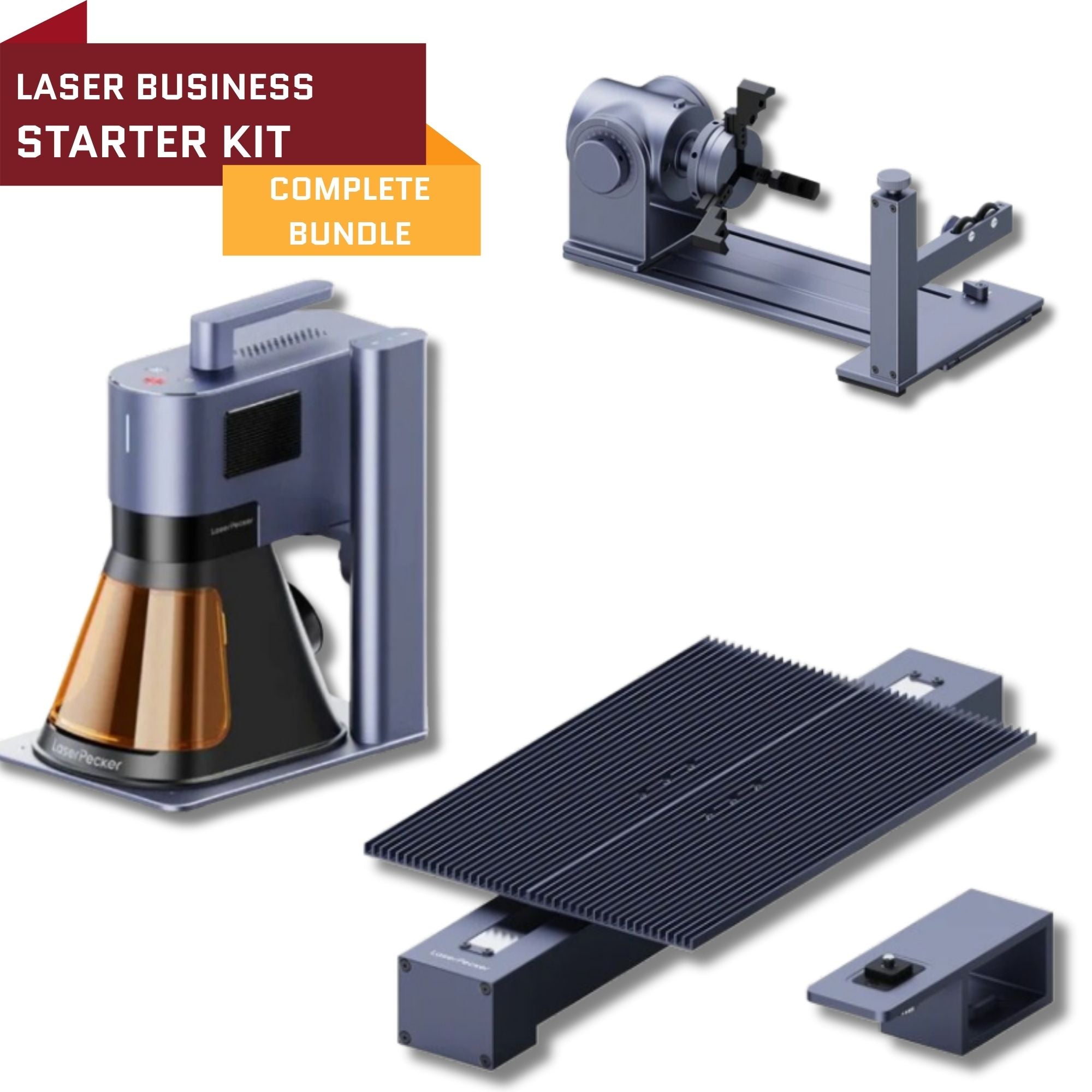
A portable, professional laser engraving system designed to help entrepreneurs launch quickly. Engrave metal, wood, leather, plastic, and more.
View Full Product DetailsThe laser engraving businesses that struggle are almost always the ones trying to do everything for everyone. The ones that thrive have a clear answer to: "who do I serve and what problem do I solve for them?"
A niche operator builds brand recognition faster, gets better at their craft faster (repetition matters), commands higher prices (perceived expertise), and generates more word-of-mouth referrals within a specific community. A generalised engraver is easy to ignore. A specialist who’s known as "the person who does incredible pet memorial pieces" or "the go-to for corporate awards in this city" is not.
Weddings and events: Enormous emotional investment means high willingness to pay. Signage, place cards, favours, keepsakes — couples spend heavily on memorable details. Repeat business is low per customer but referrals are extremely high.
Corporate gifts and branded merchandise: Steady, repeatable, bulk orders. A single relationship with a mid-size company’s marketing team can produce consistent monthly orders. Less creative, but extremely reliable revenue.
Pet memorials and personalised pet products: Emotionally charged, premium-priced, and a category that’s grown steadily. Pet owners spend money on their animals without hesitation.
Golf club and sporting equipment customisation: Premium clients paying $80–$1,500 per job, no material cost since the customer provides the equipment, and a visual social media following almost builds itself.
Firearms and industrial: Compliance engraving (serial numbers, NFA markings), customisation work, and B2B relationships with gun shops provide steady demand with high trust-based pricing.
Craft fairs and local markets: Lower average order value but high volume potential and valuable direct customer feedback for new product ideas.
Not all products are equal. The best products for a laser engraving business combine low material cost, high perceived value, fast production time, and strong repeat or referral potential.
| Product | Material Cost | Typical Sell Price | Approx. Margin |
|---|---|---|---|
| Custom tumbler | $5–$10 | $25–$50 | 60–75% |
| Engraved cutting board | $8–$15 | $40–$75 | 65–75% |
| Slate coaster set ×4 | $4–$7 | $30–$50 | 75–85% |
| Wedding sign (wood) | $10–$20 | $60–$150 | 70–85% |
| Corporate award (acrylic/wood) | $10–$25 | $75–$200 | 70–80% |
| Pet memorial plaque | $8–$15 | $50–$120 | 70–80% |
| Keychain / small accessory | $1–$3 | $15–$30 | 75–85% |
Underpricing is the single most common reason laser engraving businesses fail or plateau. Revenue looks good, orders are coming in — and the owner is working 50 hours a week making less per hour than they would at a retail job.
Final Price = (Materials + Labor + Machine Wear + Overhead) × Profit Margin
Labor rate should be a minimum of $25–$40/hour for your own time. Machine wear: $1–$2 per machine hour. Overhead per job: divide your monthly total by job count.
For wedding pieces, pet memorials, or anniversary gifts, the correct pricing question isn’t "what did this cost me?" — it’s "what is this worth to the buyer?" Price to that reality, not to your material cost.
Before-and-after transformations, close-up engraving detail shots, and satisfying process videos drive inbound demand without paid advertising. Post consistently. The businesses that build audiences in this niche post 3–5 times per week and see compounding results over 3–6 months.
Buyers searching "custom tumbler with name" or "personalised cutting board" are already committed to buying — they’re just choosing who from. Factor Etsy’s 6.5% transaction fee plus payment processing into your pricing — the total take is typically 10–15% of sale price.
One well-maintained B2B relationship can represent more consistent monthly revenue than dozens of one-off Etsy sales. Approach local businesses directly with a small sample relevant to their industry and a one-page services menu.
Run all cutting boards consecutively before switching to coasters. Every machine reset costs 5–10 minutes; eliminating those across a day of production adds up to hours recovered per week. Build a settings library: every time you dial in a material, log the speed, power, and pass count.
Clean lenses and mirrors weekly. Check belt tension and rail lubrication monthly. For CO2 lasers, track tube hours and plan for replacement before the tube fails. A $300 tube replaced proactively is far less painful than a week of lost orders.
Competing on price alone. Win on personalisation, speed, and quality — none of which a mass producer can replicate.
Undercharging and never raising prices. If you’re consistently booked out, your prices are too low.
No niche focus. Pick a category, own it, and expand from a position of strength.
Treating content creation as optional. Your social media feed is your portfolio, your marketing, and your primary acquisition channel.
A part-time operator selling personalised gifts on Etsy might make $1,000–$3,000 per month. A full-time operator with strong B2B relationships and a defined niche can exceed $8,000–$15,000 per month in revenue at 50–70% margins.
Custom tumblers, engraved cutting boards, and slate coaster sets are consistently strong starting products. They combine high perceived value with low material cost, fast production times, and strong Etsy and gift market demand.
Most operators break even within 3–12 months when focused on high-margin products and correct pricing. A $2,000 CO2 setup selling $45 cutting boards at 65% margin recovers its cost in roughly 65–70 units sold.
Saturation is a niche-level problem, not a category-level problem. An engraver positioned as the specialist in premium golf club customisation or corporate awards in their city faces far less meaningful competition than a generalist. Saturation is the wrong frame — differentiation is the right one.
Ready to launch or scale your laser engraving business? Contact our team and we’ll help you match the right equipment to your business model and budget.

Shipping Insurance ($89)
placeholder

Leave a comment