

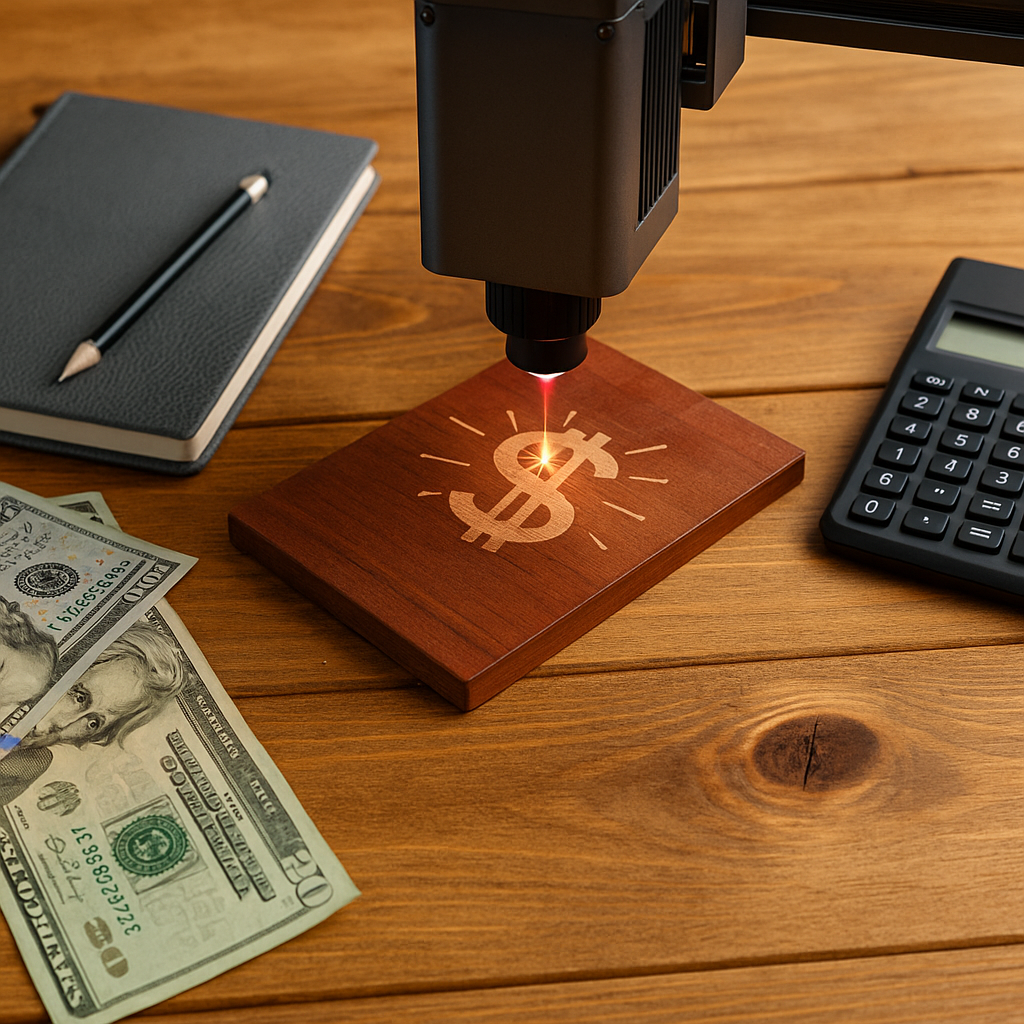
Last updated June 2026. Based on the business-planning questions our team fields from prospective laser engraving shop owners every week, the short answer is yes — a laser engraving business can be genuinely profitable, with typical margins in the 15-30% range, real examples of shops clearing $7,000 in a single holiday season on a $5,000 machine, and a meaningfully lower barrier to entry than most small manufacturing businesses. This is the complete guide: real startup costs by laser type, worked margin examples, pricing by product category, niche selection, and the platforms where engraving businesses actually sell.

Tumblers, engraved plaques, and custom jewelry consistently top the best-selling list for engraving businesses because they combine high demand with emotional value — buyers are paying for sentiment as much as the physical object, which is exactly the kind of demand that supports healthy margins. Tumblers are cheap to source and quick to engrave, making them ideal for bulk orders from sports teams, schools, or corporate gifting programs. Plaques provide steady, predictable year-round demand from schools, corporations, and award ceremonies — less exciting than custom jewelry, but a reliable revenue floor. Jewelry carries the highest margins of the three because personalization commands a real premium when someone's buying a pendant for their partner or a charm for a child; they're paying for sentiment, not metal weight.
Typical engraving businesses report 15-30% profit margins on average, though efficient operations with good supplier relationships and tight material cost control often do meaningfully better. A worked example: a stainless steel tumbler costing $6 wholesale, engraved with a custom design and sold for $25, nets a 50-60% margin after accounting for materials, electricity, and a reasonable allocation for machine wear. That's a far healthier margin than the blended 15-30% average suggests is typical — the gap comes from packaging, marketing spend, platform fees, and the inevitable mix of lower-margin items in a real product catalog.
Based on real shop feedback we've gathered, ROI can come faster than people expect going in. Many small shops cover their machine investment within 12 months when they focus deliberately on top-selling items rather than spreading thin across every possible product category. One husband-and-wife shop we heard from cleared $7,000 in their first Christmas season alone on a $5,000 CO2 laser, mostly through engraved ornaments, cutting boards, and mugs — a single strong holiday season nearly paid off their entire equipment investment.
Earnings scale predictably with focus and consistency rather than simply with time in business. Entry-level operations running part-time or as a side hustle often net $1,000-$5,000 per month once they've found a working product mix. Established shops with repeat corporate clients or wholesale relationships can bring in $10,000 or more monthly — the jump from entry-level to established income tends to track directly with how successfully a shop has moved from one-off retail customers toward repeat B2B or bulk-order relationships, which provide more predictable revenue and higher average order values than individual gift purchases.

Startup cost depends heavily on which laser type you start with, and the right choice depends entirely on which products you plan to sell first — don't buy capability you don't need yet:
Beyond the machine itself, realistic budgeting should include: $500-$1,000 for starting materials (wood blanks, acrylic sheets, leather, metal blanks across whatever product categories you're launching with), $50-$300 for design software if your machine doesn't include what you need (most ship with something functional, but serious custom design work may justify LightBurn or Illustrator), $200-$1,000 for workspace setup (proper ventilation is not optional — fume extraction protects both your health and your neighbors' tolerance for the smell, a sturdy workbench, and basic safety equipment like goggles), and $500-$1,000 for a website or marketplace presence to actually generate sales. All in, a workable, low-end professional setup starts around $1,500, while a more complete, production-ready operation typically runs $5,000-$15,000.
One genuinely smart way to reduce upfront cost and risk: start with a single multifunction machine that both cuts and engraves across wood, acrylic, and coated metals, which lets you test multiple product categories and validate actual market demand before committing capital to a second, more specialized machine. We've seen shops start with exactly this approach — beginning with plaques and signs on a versatile CO2 machine, then expanding into ornaments and keychains, and only adding a dedicated fiber laser once jewelry demand justified the larger investment.

Pricing is one of the biggest early hurdles for new shop owners — undercharge and you erode your own margin to the point where the business isn't actually sustainable; overcharge relative to perceived value and buyers hesitate at checkout. A base price plus complexity add-ons works best as a pricing structure, since it lets you capture more revenue from elaborate custom requests without having to negotiate every order individually:
Always charge more for rush jobs, complex designs, or specialty materials — these aren't just fair pricing, they're necessary to cover the real cost of disrupted workflow and increased error risk that comes with rushed or complicated orders. Consider charging separately for design setup time on custom work, which helps customers understand they're paying for artistry and design labor as well as the engraving process itself, rather than perceiving the entire price as "just the machine running." Small upsells compound quickly into meaningful revenue: a coaster set alongside an engraved cutting board, or a display stand alongside a memorial plaque, can meaningfully lift average order value without much added production effort, since the customer is already in a buying mindset.
The broad personalized-gifts market has real competition, but it isn't saturated if you pick a specific lane and own it rather than trying to compete on every product category at once. Personalized gifts remain an evergreen, reliable category, but niches like industrial engraving — tool marking, serial numbers, barcodes for manufacturing or logistics clients — are consistently lucrative and meaningfully less crowded than the consumer gift space, because fewer hobbyist-turned-business owners think to pursue B2B industrial clients.
Pet memorials, wedding keepsakes, and outdoor signage are growing sub-niches where customers actively search for local providers rather than browsing broad marketplaces, which means strong local SEO and reputation matter more than competing on price against every Etsy seller globally. The pattern that works best, based on what we've seen succeed: pick one or two of these specific niches rather than trying to serve every market simultaneously, since a shop that markets itself clearly as "the engraver for X" builds authority and word-of-mouth faster than a generalist.
Most successful engravers sell across multiple channels rather than relying on just one. Etsy provides immediate access to an audience already searching for custom, personalized gifts — strong for visibility and discovery, but with real platform fees and price competition baked in. Shopify lets you build your own brand and own your customer list, cutting out marketplace fees entirely, at the cost of having to drive your own traffic. Local retail channels — farmers' markets, boutiques, craft fairs — help build community connection and provide instant cash sales plus in-person networking that often leads to corporate or event referrals. Many successful businesses combine all three: Etsy for visibility and initial discovery, Shopify for long-term brand growth and repeat-customer relationships, and local fairs for networking and instant sales.
Seasonal timing matters enormously for revenue planning, not just marketing. Christmas ornaments, Valentine's jewelry, and graduation plaques sell heavily when marketed early — waiting until the season is already underway means missing the planning window many gift-buyers operate on. Some shops report making nearly half their annual revenue in the six weeks before Christmas alone through engraved gift bundles, which means cash flow and inventory planning for that window matters disproportionately to overall annual profitability.
The path from a $1,000-$5,000/month side business to a $10,000+/month operation usually isn't simply "work more hours on the same machine" — it typically involves a shift toward repeat B2B relationships, a second machine to handle production volume without bottlenecking on a single laser, or both. Corporate clients who reorder recognition items annually, schools that order plaques every graduation season, or wedding vendors who refer clients consistently provide a more predictable revenue base than one-off retail sales, and they're worth disproportionate effort to acquire and retain even though the per-order margin may be similar to retail.
Multifunction or higher-power machines reduce per-unit production time as volume grows, which matters more once you're filling 50-coin or 100-tumbler orders rather than single gifts — the setup-time-per-unit math changes significantly with batch size, and a faster machine pays for itself faster once you're running consistent batch orders rather than occasional individual pieces.
Entry-level operations running part-time often net $1,000-$5,000 per month, with payback on equipment typically within 18 months. Focusing on a specific high-demand niche (weddings, corporate gifts) rather than spreading across every category can shorten that payback timeline to under a year.
A diode laser ($300-$700) is the lowest-cost entry point, suitable for wood, leather, and some acrylics. It won't handle metal, so plan to upgrade to a CO2 or fiber laser once you've validated demand for your specific products rather than buying capability you don't yet need.
Jewelry and personalized gifts typically carry the highest margins because customers are paying for sentiment, not just material cost or production time. Tumblers and drinkware have lower per-unit margins but higher volume potential, especially for bulk corporate or sports-team orders, where total profit can still be substantial even with thinner per-unit margins.
The broad personalized-gifts market has real competition, but specific niches — industrial marking, pet memorials, wedding keepsakes — remain genuinely underserved relative to demand. Specializing in one or two categories and building real authority there tends to outperform trying to serve every market at once.
The shift typically comes from moving toward repeat B2B and bulk relationships — corporate clients, schools, wedding vendor referrals — rather than simply working more hours on one-off retail orders. A second machine to remove production bottlenecks usually becomes worthwhile once consistent batch orders justify the investment.
Want a sourced recommendation for which machine fits your specific product plans and budget? See our guide to the best laser engraver for small business, or reach out to our team directly.

Shipping Insurance ($89)
placeholder

Leave a comment